- ≥99% by HPLC
- Lot-matched certificate of analysis
- Ships next business day, tracked
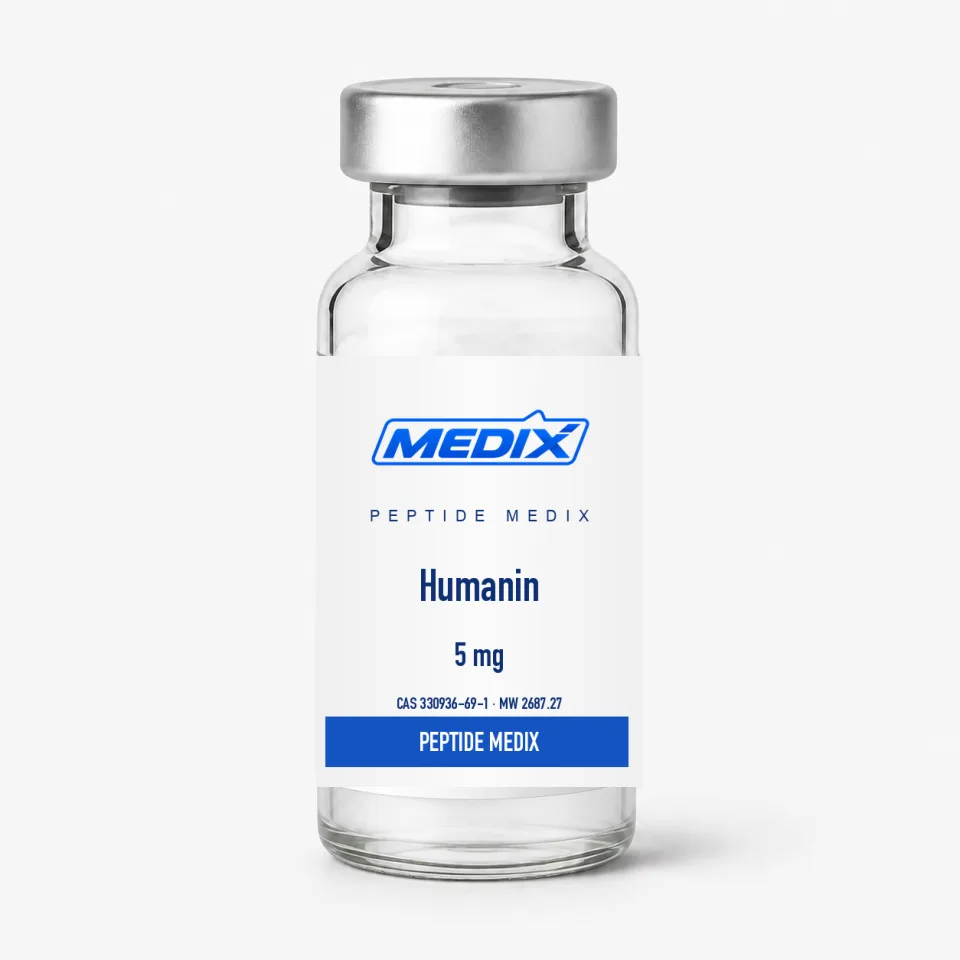
Humanin Peptide
24-residue mitochondrial-derived peptide studied for cytoprotective signaling
- FormLyophilized powder, sealed glass vial
- Mol. weight2687.27 g/mol
- Research areasCytoprotection, apoptosis signaling, neuronal survival models, metabolic and endothelial research
Overview
Humanin is a 24-amino-acid peptide encoded within the mitochondrial 16S rRNA gene (MT-RNR2) and was the first mitochondrial-derived peptide to be characterized. It was discovered in 2001 during a screen of surviving neurons from an occipital lobe sample, which is how it acquired a name that reflects the survival phenotype rather than any chemical property.
Our humanin is produced by solid-phase peptide synthesis, HPLC-purified and lyophilized into sealed vials. Every lot is verified for purity and identity, with a Certificate of Analysis available before purchase. Supplied strictly for laboratory research.
Specifications
Identity
- CAS number
- 330936-69-1
- Molecular formula
- C119H204N34O32S2
- Molecular weight
- 2687.27 g/mol
- Amino acid sequence
- Met-Ala-Pro-Arg-Gly-Phe-Ser-Cys-Leu-Leu-Leu-Leu-Thr-Ser-Glu-Ile-Asp-Leu-Pro-Val-Lys-Arg-Arg-Ala
- Peptide class
- Mitochondrial-derived peptide (MDP)
Supply & purity
- Form
- Lyophilized powder, sealed glass vial
- Purity
- ≥99% by HPLC; lot-matched COA
- Available sizes
- 5 mg, 10 mg
- Solubility
- Bacteriostatic or sterile water; may require gentle warming
Handling & storage
- Storage (lyophilized)
- −20 °C, protected from light and moisture
- Storage (reconstituted)
- 2–8 °C, used within the study window
Additional detail
- Gene of origin
- MT-RNR2 (mitochondrial 16S rRNA region)
- Research areas
- Cytoprotection, apoptosis signaling, neuronal survival models, metabolic and endothelial research
Working out the concentration
Humanin ships as a lyophilized powder, so nothing on this page can state a concentration: the figure you work with is the one you create when you add diluent. Put the vial mass and the volume you intend to use into the peptide reconstitution calculator and it returns mg/mL, mcg/mL and the mass sitting at each mark on a U-100 syringe.
For work specified in µM or nM rather than mg/mL, feed 2687.27 g/mol and your volume into the peptide molarity calculator.
Certificate of analysis
Every lot of Humanin is released against a certificate of analysis: the batch-specific laboratory data for that lot, not a generic document for the compound. The lot number on the certificate matches the lot number printed on the label you receive — the vial label itself, where the product is vialled — so the record and the material it describes can always be reconciled.
Purity: ≥99% by HPLC — the specification for this listing. The figure for the lot you receive is the one reported on that lot’s certificate.
No lot certificate is on display on this page at the moment. That is a publishing state and not a testing one: lots are released and documented as described above whether or not the document is posted here, and we will send what exists for the lot in stock, or for a lot already on your bench, by its number.
Certificates are available on request before you order as well as after, with no account and no charge. Request the certificate for this listing, read the testing and documentation policy in full, or see how to read a peptide COA.
Questions about Humanin
What is humanin?
Humanin is a 24-amino-acid peptide encoded in the mitochondrial 16S rRNA gene and was the first mitochondrial-derived peptide identified. It is studied in laboratory models of cell survival, apoptosis signaling and metabolic regulation.
Is this humanin third-party tested?
Yes. Every lot is analyzed by HPLC for purity of ≥99% and by mass spectrometry for identity, and the lot-matched Certificate of Analysis is available on this page before purchase so you can review the data with your own acceptance criteria.
How does humanin differ from MOTS-c?
Both are mitochondrial-derived peptides but they come from different regions of mitochondrial DNA and have different sequences and lengths. Humanin is 24 residues from the 16S rRNA gene; MOTS-c is 16 residues from the 12S region, and their reported signaling profiles differ.
Why is my humanin slow to dissolve?
The sequence contains a leucine-rich hydrophobic core, so it dissolves more slowly than short hydrophilic peptides. Add diluent gently, allow several minutes with swirling, and warm to roughly 25–30 °C if needed rather than shaking the vial.
Related