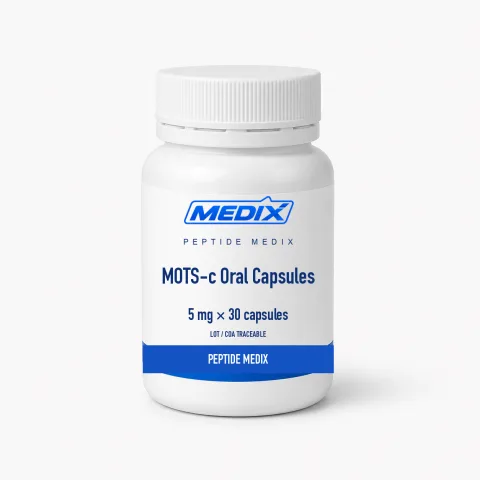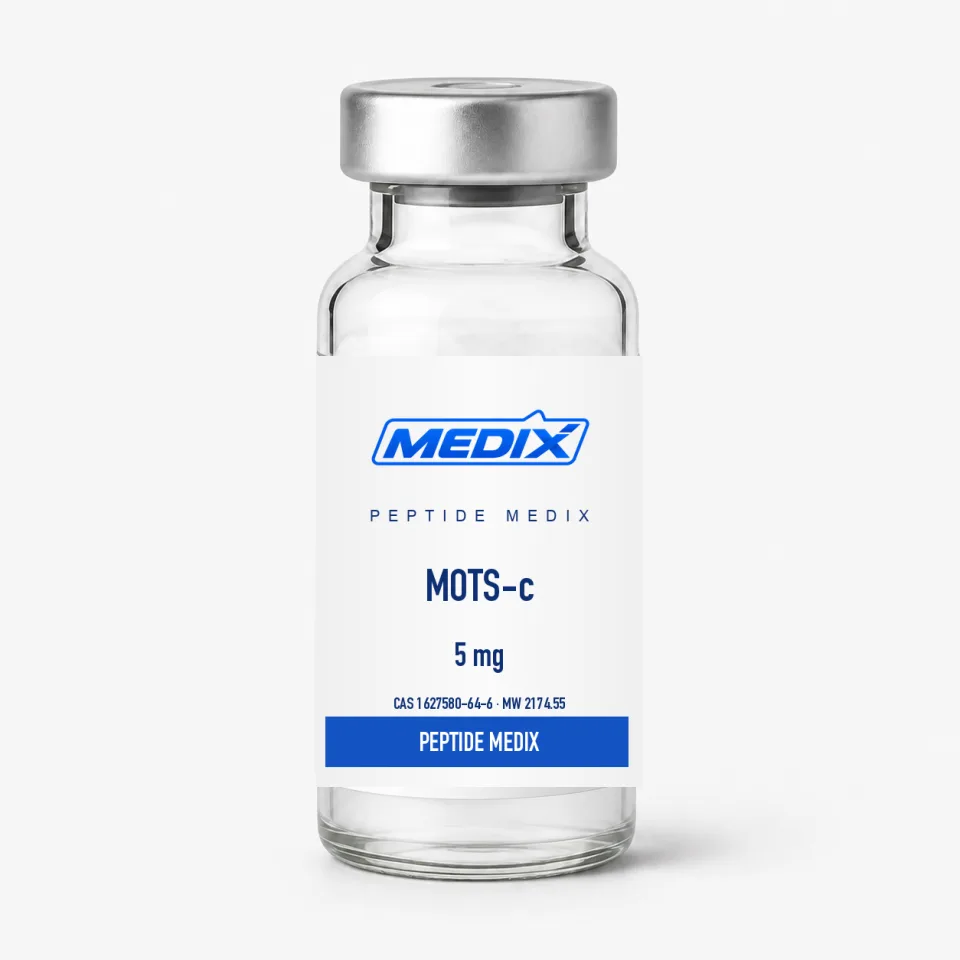
- ≥99% by HPLC
- Lot-matched certificate of analysis
- Ships next business day, tracked
MOTS-c Peptide
16-amino-acid mitochondrial-derived peptide for metabolic signaling research
- FormLyophilized powder, sealed glass vial
- Mol. weight2174.55 g/mol
- Research areasAMPK signaling, glucose and lipid metabolism, mitochondrial stress response, exercise physiology
Overview
MOTS-c (mitochondrial open reading frame of the twelve S rRNA type-c) is a 16-amino-acid peptide encoded not in the nuclear genome but within the mitochondrial 12S rRNA gene. It belongs to the small family of mitochondrial-derived peptides (MDPs) alongside humanin and the SHLP series, and it was first described in 2015 as a signal that mitochondria appear to send to the rest of the cell about their metabolic state.
Because the open reading frame sits in mitochondrial DNA, the peptide is translated with the mitochondrial genetic code, in which AGA and AGG act as termination signals rather than coding for arginine — a detail that matters whenever the sequence is expressed recombinantly rather than synthesised chemically. The reported biology centres on AMPK activation and, in the original description, on folate and methionine one-carbon metabolism, with downstream measurements of glucose uptake, fatty-acid oxidation and mitochondrial stress responses; exercise physiology has been a productive setting for it. The sequence carries two methionines and a tryptophan, all oxidation-prone, so solutions are protected from light and used within a defined window. Fills run from 5 mg for pilot work up to 40 mg for extended series on a single lot.
Specifications
Identity
- CAS number
- 1627580-64-6
- Molecular formula
- C101H152N28O22S2
- Molecular weight
- 2174.55 g/mol
- Amino acid sequence
- Met-Arg-Trp-Gln-Glu-Met-Gly-Tyr-Ile-Phe-Tyr-Pro-Arg-Lys-Leu-Arg
- Chain length
- 16 amino acids
- Peptide class
- Mitochondrial-derived peptide (MDP)
Supply & purity
- Form
- Lyophilized powder, sealed glass vial
- Purity
- ≥99% by HPLC; lot-matched COA
- Available sizes
- 5 mg, 10 mg, 20 mg, 40 mg
- Solubility
- Bacteriostatic or sterile water; aqueous buffers
Handling & storage
- Storage (lyophilized)
- −20 °C, protected from light and moisture
- Storage (reconstituted)
- 2–8 °C, used within the study window
Additional detail
- Research areas
- AMPK signaling, glucose and lipid metabolism, mitochondrial stress response, exercise physiology
Working out the concentration
The vial sizes above — 5 mg, 10 mg, 20 mg, 40 mg — describe a mass of material, not a strength. Choose a diluent volume, work it out with the reconstitution calculator, and you have the concentration for your own vial of MOTS-c plus the volume that carries any mass you want to withdraw.
For work specified in µM or nM rather than mg/mL, feed 2174.55 g/mol and your volume into the peptide molarity calculator.
Certificate of analysis
Every lot of MOTS-c is released against a certificate of analysis: the batch-specific laboratory data for that lot, not a generic document for the compound. The lot number on the certificate matches the lot number printed on the label you receive — the vial label itself, where the product is vialled — so the record and the material it describes can always be reconciled.
Purity: ≥99% by HPLC — the specification for this listing. The figure for the lot you receive is the one reported on that lot’s certificate.
No lot certificate is on display on this page at the moment. That is a publishing state and not a testing one: lots are released and documented as described above whether or not the document is posted here, and we will send what exists for the lot in stock, or for a lot already on your bench, by its number.
Certificates are available on request before you order as well as after, with no account and no charge. Request the certificate for this listing, read the testing and documentation policy in full, or see how to read a peptide COA.
Questions about MOTS-c
What is MOTS-c?
MOTS-c is a 16-amino-acid peptide encoded within the mitochondrial 12S rRNA gene rather than in nuclear DNA. It is classified as a mitochondrial-derived peptide and is studied in laboratory models of energy metabolism, AMPK signaling and mitochondrial stress responses.
Is this MOTS-c third-party tested?
Yes. Every lot is analyzed by HPLC for purity and by mass spectrometry for identity, and a lot-matched Certificate of Analysis is available on the product page before you order. The COA documents purity, mass confirmation and the analytical methods used.
What sizes are available?
MOTS-c is supplied in 10 mg, 20 mg and 40 mg lyophilized vials. Larger vials reduce the per-milligram cost for laboratories running extended studies, while the 10 mg vial suits pilot experiments and assay development.
How should MOTS-c be stored?
Store the lyophilized powder at −20 °C, protected from light and moisture; at that temperature the material is stable for long periods. Once reconstituted, keep the solution refrigerated at 2–8 °C, aliquot it, and minimize freeze–thaw cycles.
What is MOTS-c dissolved in?
Bacteriostatic water is the most common reconstitution medium in research workflows, and sterile water or standard aqueous buffers are also used depending on the assay. Add diluent slowly along the vial wall and swirl rather than shake.
Is MOTS-c related to humanin?
Both are mitochondrial-derived peptides encoded in mitochondrial DNA, but they are distinct molecules with different sequences, lengths and reported signaling profiles. Humanin is a 24-residue peptide from the 16S rRNA region; MOTS-c is 16 residues from the 12S region.
Related