- Lot-matched certificate of analysis
- Ships next business day, tracked
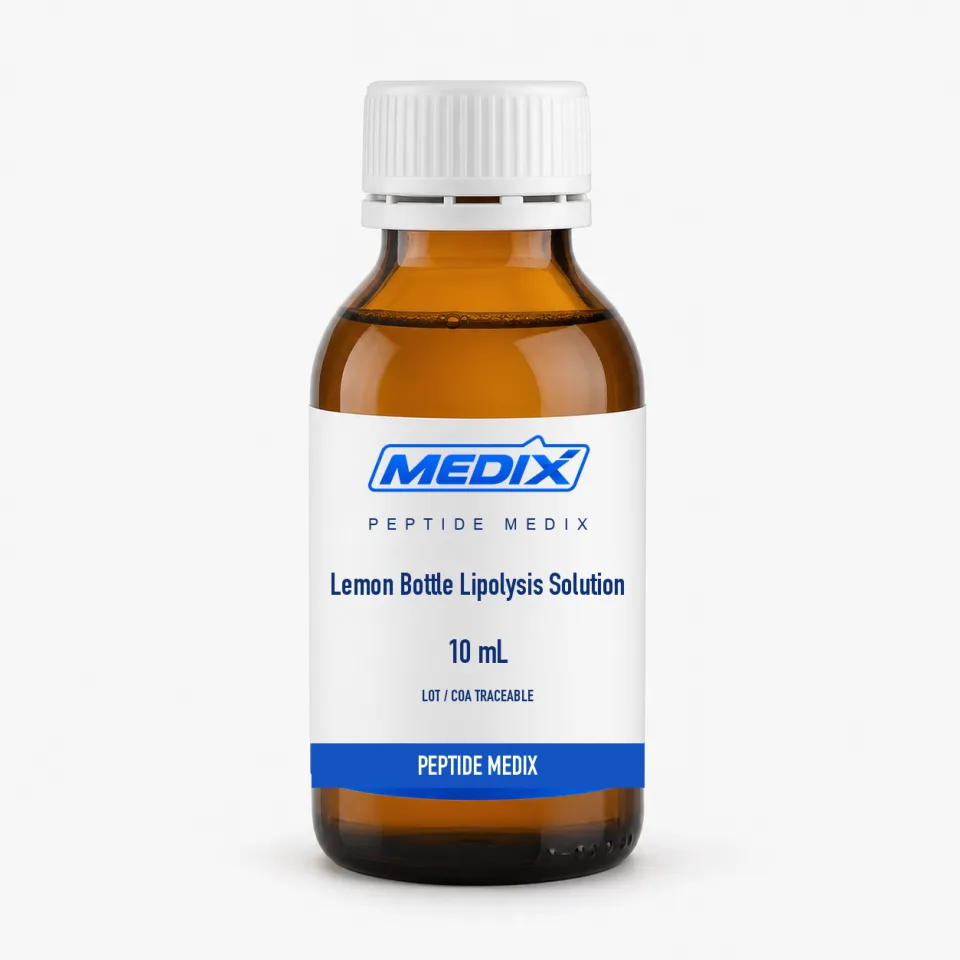
Lemon Bottle Lipolysis Solution
Aqueous bromelain, riboflavin and lecithin lipolysis solution, 10 mL vials
- FormPre-mixed aqueous solution, sealed 10 mL vial
- Research areasAdipocyte viability and lipolysis assays, membrane-disruption models, enzyme-formulation stability
Overview
Each vial holds 10 mL of clear to pale-yellow solution and is offered singly or as a five-vial pack for larger study series. It arrives pre-mixed, so no reconstitution, weighing or solvent handling is required — the vial is entered directly for sampling.
Three components of unrelated chemistry sit in the same aqueous base, which is part of what makes the mixture awkward to characterise and interesting to study. Bromelain is a cysteine protease complex from pineapple (Ananas comosus) stem, so the preparation carries enzymatic activity that a simple surfactant solution would not. Riboflavin, C17H20N4O6 at 376.36 g/mol, is an intensely coloured and photolabile flavin. Lecithin is a phosphatidylcholine-rich phospholipid acting as an emulsifier. Benchwork on formulations of this type concentrates on adipocyte viability and lipolysis assays, membrane-disruption endpoints and enzyme-formulation stability, where the protease and the surfactant contributions have to be separated from one another. The formulation is of South Korean origin and arrives at a fixed composition, so lot-to-lot comparison rests on the stated composition rather than on weighing out components individually.
Specifications
Supply & purity
- Form
- Pre-mixed aqueous solution, sealed 10 mL vial
- Available sizes
- 10 mL single vial; 10 mL × 5 pack
Additional detail
- Appearance
- Clear to pale-yellow liquid; colour derives from riboflavin
- Stated composition
- Bromelain, riboflavin (vitamin B2) and lecithin in an aqueous base
- Bromelain
- Cysteine protease complex from pineapple (Ananas comosus) stem
- Riboflavin
- Vitamin B2, C17H20N4O6, 376.36 g/mol; light-sensitive flavin
- Lecithin
- Phosphatidylcholine-rich phospholipid mixture used as an emulsifier
- Origin
- Formulation of South Korean origin
- Reconstitution
- None required — supplied ready to sample
- Research areas
- Adipocyte viability and lipolysis assays, membrane-disruption models, enzyme-formulation stability
- Storage
- 2–8 °C, upright and protected from light; do not freeze
- Stability note
- Riboflavin photodegrades and proteases lose activity when warm — keep cold and dark
- Regulatory status
- Not an approved drug or device in the United States; not a cosmetic for human application
Units and conversions
Lemon Bottle Lipolysis Solution arrives already made up, so there is no diluent volume to choose and no reconstitution step. What is left is unit work — percent to mg/mL, milligrams to micrograms, millilitres to microlitres — and the mcg to mg converter does all three.
Certificate of analysis
Every lot of Lemon Bottle Lipolysis Solution is released against its own lot documentation, and where the manufacturer issues a certificate of analysis for it, that certificate is the record for the lot rather than a generic document for the compound. The lot number on the certificate matches the lot number printed on the label you receive — the vial label itself, where the product is vialled — so the record and the material it describes can always be reconciled.
This listing carries no purity percentage, so none is claimed for it here. Where the manufacturer issues analytical documentation for a lot of this item, it is passed on unaltered — ask and we will send whatever exists.
No lot certificate is on display on this page at the moment. That is a publishing state and not a testing one: lots are released and documented as described above whether or not the document is posted here, and we will send what exists for the lot in stock, or for a lot already on your bench, by its number.
Certificates are available on request before you order as well as after, with no account and no charge. Request the certificate for this listing, read the testing and documentation policy in full, or see how to read a peptide COA.
Questions about Lemon Bottle Lipolysis Solution
What is actually in the solution?
The stated composition is bromelain, a protease complex from pineapple stem, together with riboflavin (vitamin B2) and lecithin in an aqueous base. It is supplied pre-mixed at a fixed concentration, so no weighing or reconstitution is required before sampling.
Why is the liquid yellow?
Riboflavin is an intensely yellow flavin compound, and its presence gives the solution its colour. That colour doubles as a practical stability indicator: riboflavin photodegrades readily, so a visible fade after light exposure is a sign the preparation has not been stored correctly.
How should it be stored?
Refrigerate at 2–8 °C, upright and away from light, and do not freeze. Enzyme activity declines when the preparation is warm and riboflavin degrades under light, so both temperature and light exposure are worth logging alongside experimental results.
Does it need to be reconstituted?
No. Unlike lyophilized peptide vials, this product ships as a ready-mixed aqueous solution. Warm the vial to room temperature, swab the septum and draw directly. No diluent, bacteriostatic water or solvent preparation step is involved.
Related