- ≥99% by HPLC
- Lot-matched certificate of analysis
- Ships next business day, tracked
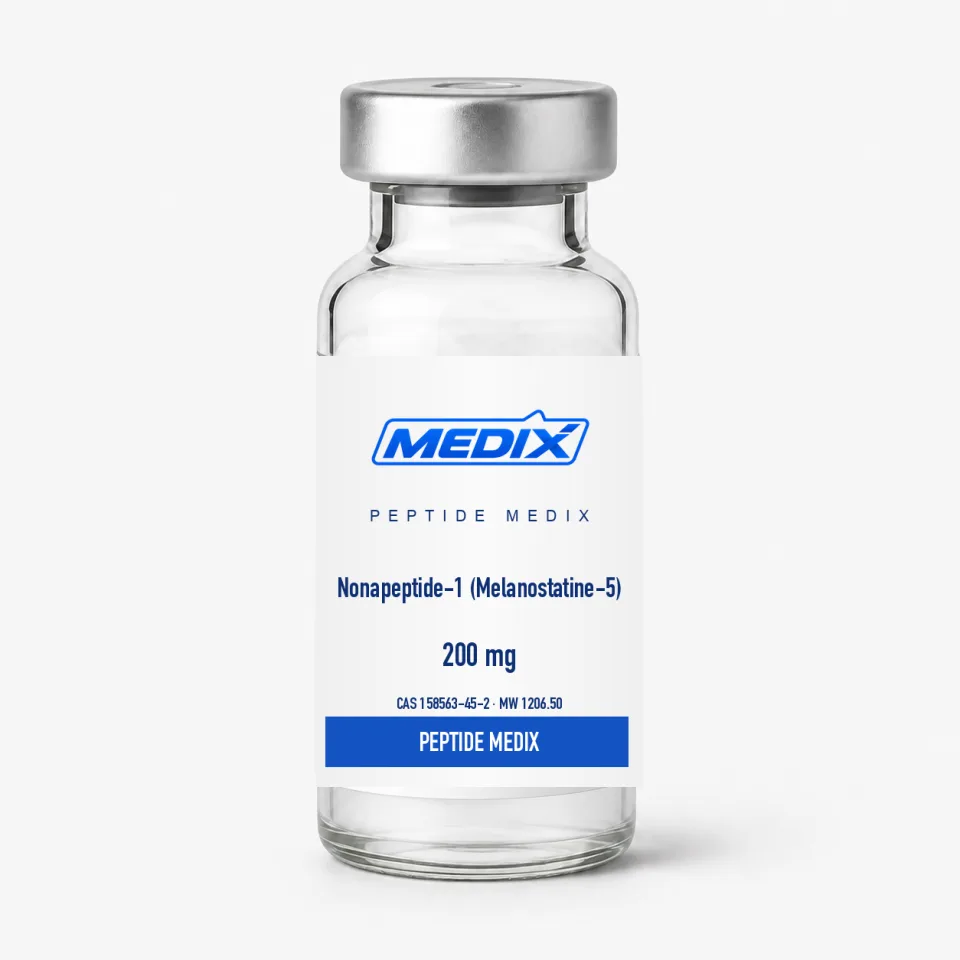
Nonapeptide-1 (Melanostatine-5)
Nine-residue amidated MC1R-antagonist peptide for melanogenesis models
- FormLyophilized powder, sealed glass vial
- Mol. weight1206.50 g/mol
- Research areasAlpha-MSH competition, MC1R signaling, tyrosinase regulation and melanogenesis
Overview
Nonapeptide-1 is a synthetic nine-residue amidated peptide also known as Melanostatine-5. Its sequence—Met-Pro-D-Phe-Arg-D-Trp-Phe-Lys-Pro-Val-NH2—contains two D-amino acids that stabilize the conformation and distinguish it from an ordinary all-L peptide. The internal Phe-Arg-Trp run echoes part of the His-Phe-Arg-Trp message motif shared by melanocortin ligands, although the histidine of that motif is not present in this analogue. It was identified through melanocortin peptide-library work as an antagonist candidate at melanocortin-1 receptor (MC1R).
It is stocked in a single 200 mg vial, an unusually large fill for a peptide at this price, and the reason is the work it is bought for: melanogenesis models and topical formulation studies consume material at a rate that milligram vials cannot support. Assay use is competitive in design, with the peptide characterised against alpha-MSH at MC1R and readouts including cyclic-AMP accumulation, tyrosinase activity and melanin content in melanocyte or melanoma cell culture. Melanotan I, the tridecapeptide alpha-MSH analogue listed elsewhere in this catalogue, occupies the agonist end of the same receptor pharmacology and is the obvious comparison arm. The lyophilized powder is held at −20 °C, with both powder and solutions protected from light.
Specifications
Identity
- CAS number
- 158563-45-2
- Molecular formula
- C61H87N15O9S
- Molecular weight
- 1206.50 g/mol
- Amino acid sequence
- Met-Pro-D-Phe-Arg-D-Trp-Phe-Lys-Pro-Val-NH2
- Chain length
- 9 residues, C-terminally amidated
Supply & purity
- Form
- Lyophilized powder, sealed glass vial
- Purity
- ≥99% by HPLC; lot-matched COA available
Additional detail
- Available size
- 200 mg
- Also known as
- Melanostatine-5, Melanostatine 5, Nonapeptide-1
- Research target
- Melanocortin-1 receptor (MC1R) antagonist models
- Research areas
- Alpha-MSH competition, MC1R signaling, tyrosinase regulation and melanogenesis
- Storage
- −20 °C lyophilized; protect powder and solutions from light
Working out the concentration
Because Nonapeptide-1 (Melanostatine-5) arrives dry, its concentration is a decision rather than a specification. Run the numbers through the reconstitution calculator — vial mass in, diluent volume in, mg/mL and mass per syringe unit out.
Certificate of analysis
Every lot of Nonapeptide-1 (Melanostatine-5) is released against a certificate of analysis: the batch-specific laboratory data for that lot, not a generic document for the compound. The lot number on the certificate matches the lot number printed on the label you receive — the vial label itself, where the product is vialled — so the record and the material it describes can always be reconciled.
Purity: ≥99% by HPLC — the specification for this listing. The figure for the lot you receive is the one reported on that lot’s certificate.
No lot certificate is on display on this page at the moment. That is a publishing state and not a testing one: lots are released and documented as described above whether or not the document is posted here, and we will send what exists for the lot in stock, or for a lot already on your bench, by its number.
Certificates are available on request before you order as well as after, with no account and no charge. Request the certificate for this listing, read the testing and documentation policy in full, or see how to read a peptide COA.
Questions about Nonapeptide-1 (Melanostatine-5)
What is Nonapeptide-1?
It is a synthetic nine-residue peptide, also called Melanostatine-5, developed as an antagonist candidate for MC1R signaling. The sequence includes D-phenylalanine and D-tryptophan and ends in a C-terminal amide.
How does Nonapeptide-1 differ from Decapeptide-12?
Nonapeptide-1 is studied primarily at the receptor-signaling level through MC1R and alpha-MSH competition. Decapeptide-12 is studied more directly as a tyrosinase inhibitor. They address different steps in melanogenesis and are useful comparison reagents, not duplicates.
Why are D-amino acids important in the sequence?
D-Phe3 and D-Trp5 alter the peptide's three-dimensional geometry and protease susceptibility. A material made with the corresponding L residues would not be the same research compound even if the residue names looked similar on a label.
What purity documentation is available?
Each lot is analyzed by reversed-phase HPLC to at least 99% purity and is accompanied by a lot-matched certificate of analysis on request. Mass confirmation should match the amidated peptide form.
How should Nonapeptide-1 be stored?
Store the sealed powder at −20 °C, protected from moisture and light. Keep prepared solutions refrigerated for a defined study window and use aliquots when work extends across multiple sessions.
Related