- HPLC tested
- Lot-matched certificate of analysis
- Ships next business day, tracked
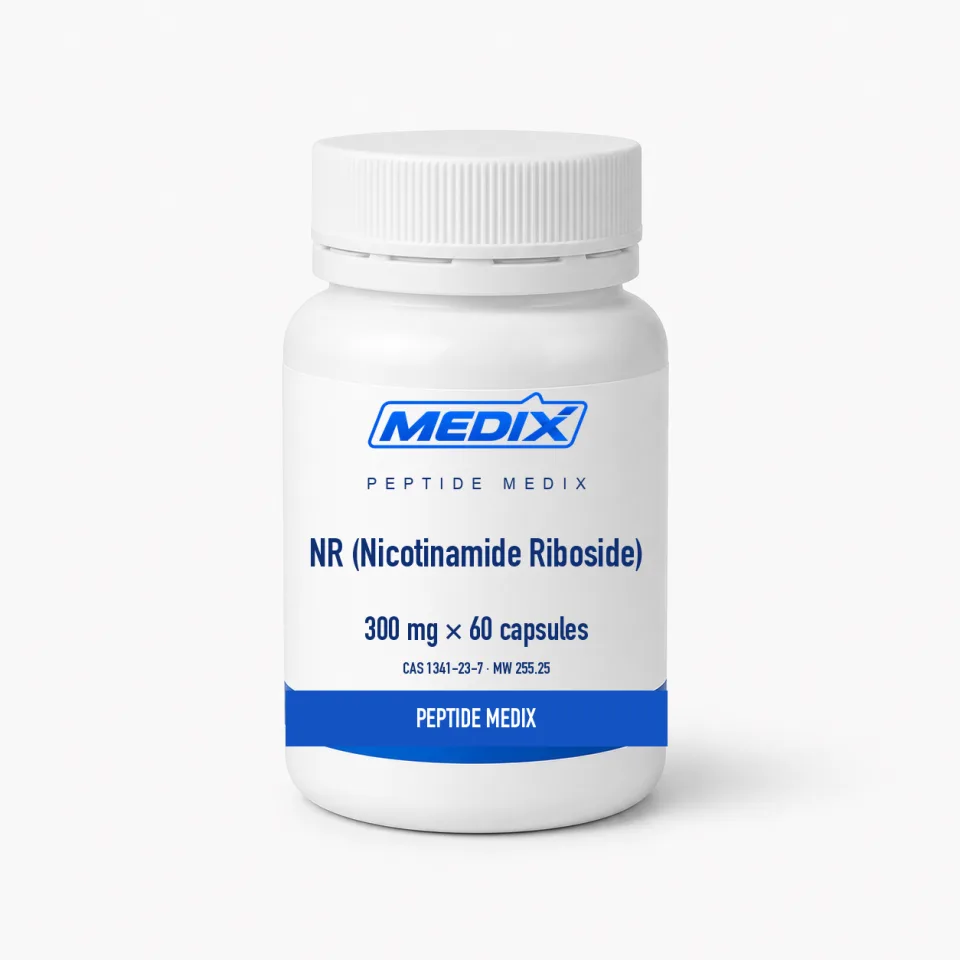
NR (Nicotinamide Riboside)
Nicotinamide riboside, a pyridine nucleoside NAD+ precursor, 300 mg capsules
- FormOral capsules in a sealed bottle with desiccant
- Mol. weight255.25 g/mol (nicotinamide riboside cation)
- Research areasNAD+ salvage flux, sirtuin and PARP biology, mitochondrial function, aging models
Overview
Nicotinamide riboside is the ribosyl nucleoside form of vitamin B3: a nicotinamide base joined to ribose, without the phosphate group that NMN carries. It was identified as a distinct NAD+ precursor when a dedicated salvage route was described in yeast, and the corresponding mammalian enzymes — nicotinamide riboside kinases NRK1 and NRK2 — phosphorylate it to NMN, which is then adenylylated to NAD+ by NMNAT enzymes.
That two-step route is why NR is used as a research tool rather than simply another form of niacin. Because it enters the pathway downstream of nicotinamide phosphoribosyltransferase, it lets investigators raise NAD+ availability in models where that enzyme is limiting or inhibited, and it can be traced isotopically to distinguish direct nucleoside uptake from breakdown to nicotinamide by purine nucleoside phosphorylase in the gut and liver. NAD+ itself is the substrate for sirtuins, PARPs and CD38, so precursor availability sits upstream of a large body of metabolic and aging research.
Specifications
Identity
- CAS number
- 1341-23-7
- Molecular weight
- 255.25 g/mol (nicotinamide riboside cation)
Supply & purity
- Form
- Oral capsules in a sealed bottle with desiccant
- Purity
- HPLC tested; lot-matched COA available
- Available sizes
- 300 mg × 60 capsules
- Solubility
- Freely soluble in water; the chloride salt is hygroscopic and acid-stable
Additional detail
- Common salt form
- Nicotinamide riboside chloride, CAS 23111-00-4, 290.70 g/mol
- Compound class
- Pyridine nucleoside; vitamin B3 vitamer and NAD+ precursor
- Also known as
- NR, niagen, nicotinamide ribofuranoside
- Metabolic route
- NR → NMN via NRK1/NRK2 → NAD+ via NMNAT1-3
- Competing route
- Cleavage to nicotinamide and ribose by purine nucleoside phosphorylase
- Research areas
- NAD+ salvage flux, sirtuin and PARP biology, mitochondrial function, aging models
- Storage
- Room temperature in the sealed bottle, dry and protected from light; refrigeration extends shelf life
Units and conversions
Capsule and troche strengths are stated per unit, so the figure a method needs is usually a conversion rather than a dilution. The mcg to mg converter handles the milligram-to-microgram step, and the millilitre arithmetic if you are working from a solution format instead.
Certificate of analysis
Every lot of NR (Nicotinamide Riboside) is released against a certificate of analysis: the batch-specific laboratory data for that lot, not a generic document for the compound. The lot number on the certificate matches the lot number printed on the label you receive — the vial label itself, where the product is vialled — so the record and the material it describes can always be reconciled.
Purity: HPLC tested — the specification for this listing. The figure for the lot you receive is the one reported on that lot’s certificate.
No lot certificate is on display on this page at the moment. That is a publishing state and not a testing one: lots are released and documented as described above whether or not the document is posted here, and we will send what exists for the lot in stock, or for a lot already on your bench, by its number.
Certificates are available on request before you order as well as after, with no account and no charge. Request the certificate for this listing, read the testing and documentation policy in full, or see how to read a peptide COA.
Questions about NR (Nicotinamide Riboside)
How does NR differ from NMN?
Nicotinamide riboside is the unphosphorylated nucleoside; NMN is its 5'-phosphate. NR must be phosphorylated by NRK1 or NRK2 before it can be adenylylated to NAD+, whereas NMN is already at that stage. Which precursor is more efficient in a given tissue remains an active research question.
Which salt form is supplied?
The material is normally the chloride salt, nicotinamide riboside chloride, because the free base is unstable as a solid. The molecular weight of 255.25 g/mol quoted here refers to the nicotinamide riboside cation; the chloride salt has a formula weight of about 290.70 g/mol.
What documentation comes with it?
Each lot is HPLC tested for purity and identity, and a lot-matched certificate of analysis is available for the bottle shipped. That matters for this compound because degradation to nicotinamide is the common quality failure and shows up clearly on a chromatogram.
What has research examined?
Published work covers NAD+ salvage flux, sirtuin and PARP activity, mitochondrial respiratory capacity, hepatic metabolism in diet-induced models, and neuronal and cochlear protection after injury. Isotope-tracing studies have also probed how much intact nucleoside reaches peripheral tissue.
How should it be stored?
Store the sealed bottle at room temperature, dry and away from light, or refrigerated for longer holds. The chloride salt is hygroscopic, so keep the desiccant in place and minimise open time. Prepare aqueous solutions fresh and avoid alkaline conditions, which accelerate hydrolysis.
Related