- Lot-matched certificate of analysis
- Ships next business day, tracked
PDRN (Polydeoxyribonucleotide, Salmon DNA)
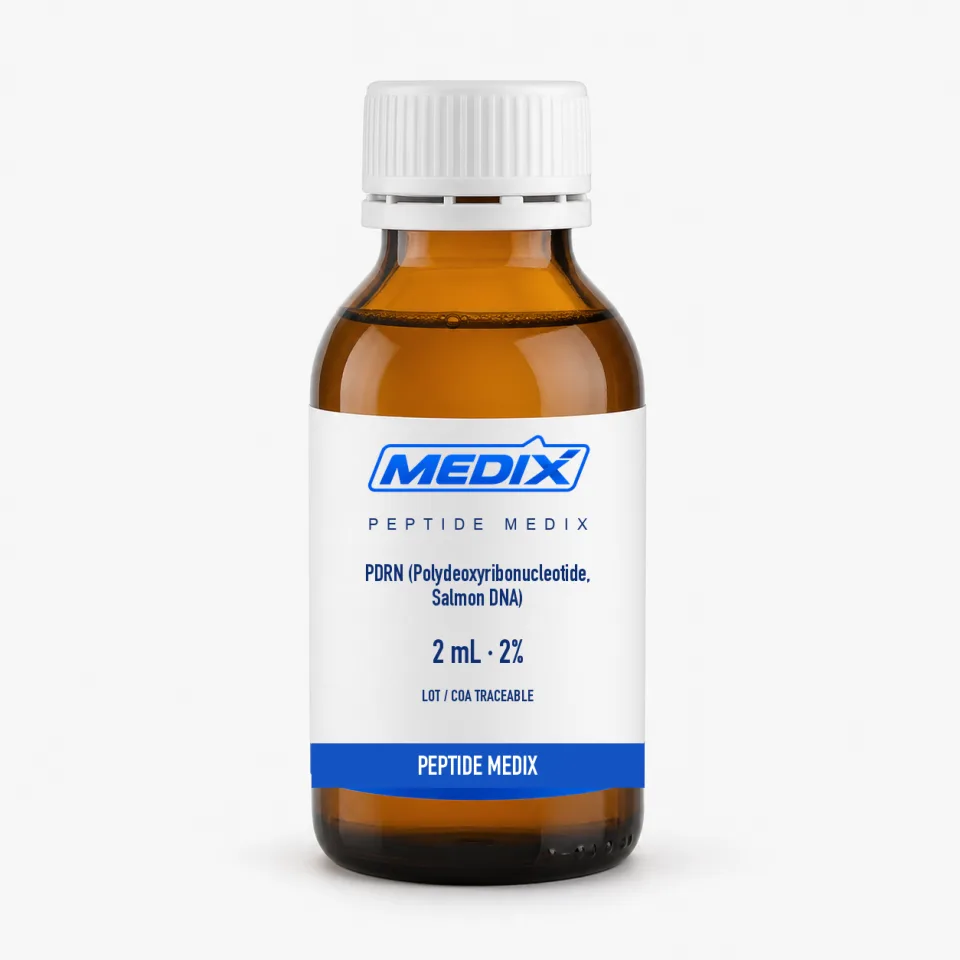
2% polydeoxyribonucleotide solution from salmon DNA, 2 mL and 5 mL vials
- FormClear aqueous solution in a sealed glass vial; supplied ready to sample
- Research areasAngiogenic signalling, fibroblast proliferation, extracellular matrix and collagen synthesis, inflammatory markers, wound models
Overview
PDRN stands for polydeoxyribonucleotide: a mixture of short DNA fragments, typically cited in the range of roughly 50 to 1,500 kilodaltons, produced by controlled extraction and enzymatic fragmentation of DNA from salmonid gonadal tissue. It is not a peptide and not a single defined molecule — it is a characterised polymer preparation, which is why lot documentation describes a fragment-size distribution and purity rather than a formula and molecular weight.
Salmon DNA is used because its nucleotide sequence composition is close enough to human DNA to be handled by the same salvage enzymes, while the source material is abundant and the purification process removes protein and peptide contaminants that would otherwise complicate an assay. Our material is supplied as a ready-to-sample 2% aqueous solution in sealed 2 mL and 5 mL vials, so no reconstitution step is required and the concentration is fixed and known.
Specifications
Supply & purity
- Form
- Clear aqueous solution in a sealed glass vial; supplied ready to sample
- Available sizes
- 2 mL at 2%; 5 mL at 2%
Additional detail
- Concentration
- 2% w/v (20 mg/mL polydeoxyribonucleotide)
- Active
- Polydeoxyribonucleotide (PDRN), a mixture of low-molecular-weight DNA fragments
- Source material
- DNA purified from salmonid (Oncorhynchus) gonadal tissue
- Fragment size
- Commonly cited at approximately 50–1,500 kDa; a distribution rather than a single mass
- Chemical class
- Nucleic acid polymer — deoxyribonucleotide chains, not a peptide
- Proposed mechanisms
- Adenosine A2A receptor agonism; nucleotide supply to the purine salvage pathway
- Research areas
- Angiogenic signalling, fibroblast proliferation, extracellular matrix and collagen synthesis, inflammatory markers, wound models
- Related preparation
- PN (polynucleotide) preparations use longer chains from the same source chemistry
- Appearance
- Clear, colourless to very faintly opalescent liquid, free of visible particulates
- Storage
- 2–8 °C, upright, protected from light; do not freeze
Units and conversions
This is a pre-mixed presentation: the strength is fixed at fill, and the only arithmetic between the label and the bench is a change of units. The peptide unit converter moves between mg, mcg, mL and µL without the decimal-point slip that costs a whole run.
Certificate of analysis
Every lot of PDRN (Polydeoxyribonucleotide, Salmon DNA) is released against its own lot documentation, and where the manufacturer issues a certificate of analysis for it, that certificate is the record for the lot rather than a generic document for the compound. The lot number on the certificate matches the lot number printed on the label you receive — the vial label itself, where the product is vialled — so the record and the material it describes can always be reconciled.
This listing carries no purity percentage, so none is claimed for it here. Where the manufacturer issues analytical documentation for a lot of this item, it is passed on unaltered — ask and we will send whatever exists.
No lot certificate is on display on this page at the moment. That is a publishing state and not a testing one: lots are released and documented as described above whether or not the document is posted here, and we will send what exists for the lot in stock, or for a lot already on your bench, by its number.
Certificates are available on request before you order as well as after, with no account and no charge. Request the certificate for this listing, read the testing and documentation policy in full, or see how to read a peptide COA.
Questions about PDRN (Polydeoxyribonucleotide, Salmon DNA)
What is PDRN?
PDRN, or polydeoxyribonucleotide, is a mixture of short DNA fragments purified from salmonid DNA and cut to a defined size range, commonly cited as roughly 50 to 1,500 kDa. It is a nucleic acid preparation rather than a peptide, and it is characterised by fragment-size distribution and purity rather than by a molecular formula.
Why is salmon DNA used as the source?
Salmonid gonadal tissue is an abundant, well-characterised DNA source whose nucleotide composition is close enough to human DNA to be processed by the same salvage enzymes in experimental systems. The purification process is designed to strip protein and peptide contaminants that would otherwise confound results.
How does PDRN differ from PN (polynucleotide) preparations?
Both come from the same source chemistry. PN preparations retain longer chains and are studied more for their physical, gel-forming and biostimulatory properties, while PDRN is fragmented further and is studied more for receptor and salvage-pathway activity. Fragment length is the practical difference.
Does the product need reconstitution?
No. It is supplied as a ready-to-sample 2% aqueous solution — 20 mg/mL — in a sealed vial, so the concentration is fixed and known. Laboratories dilute it into buffer or vehicle as their protocol requires rather than preparing it from a powder.
Is a certificate of analysis available?
Yes. Each lot carries a matched certificate of analysis reporting identity, concentration and purity for that specific batch. Because PDRN is a preparation rather than a single molecule, we recommend recording the lot number alongside experimental data so results can be traced to its size profile.
How should PDRN be stored?
Refrigerated at 2–8 °C, upright and protected from light. Do not freeze the solution: freeze–thaw cycles can shift the fragment-size distribution that defines the material. Vials should be kept sealed until use and drawn with aseptic technique.
Related