- Lot-matched certificate of analysis
- Ships next business day, tracked
Metabolic & Circadian Compounds
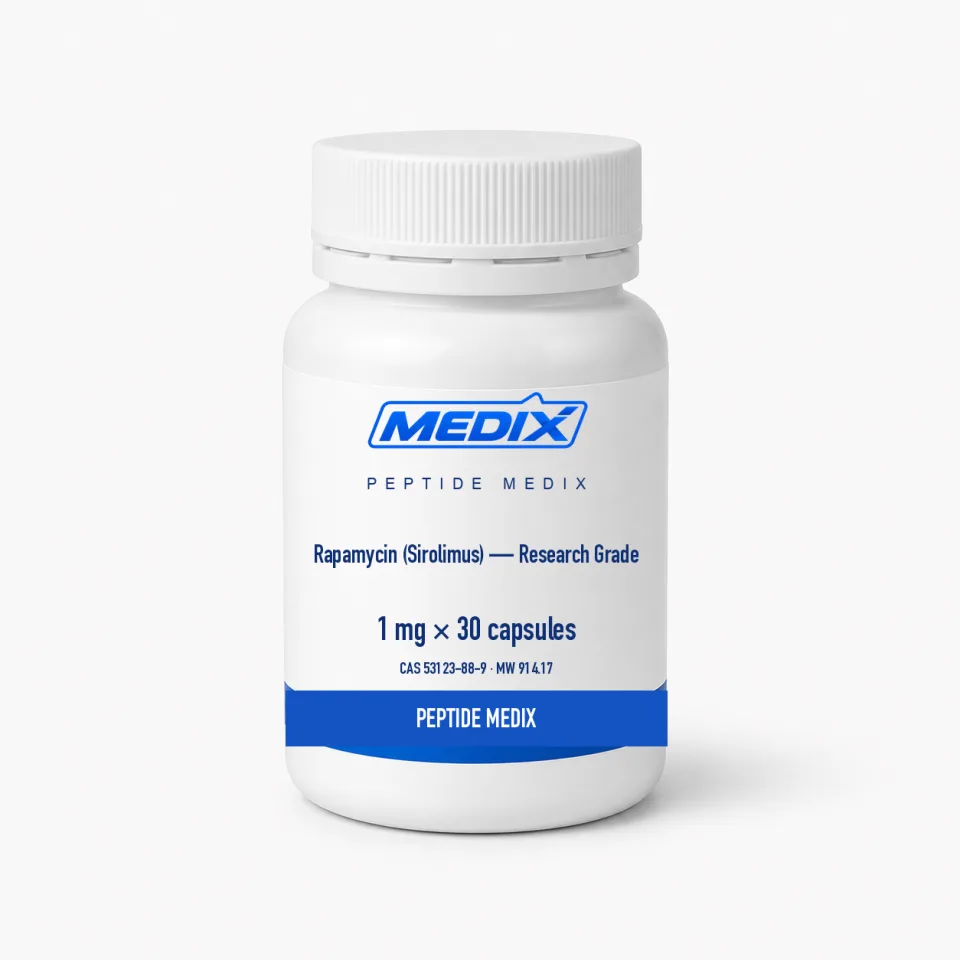
Rapamycin (Sirolimus) — Research Grade
Macrolide mTOR inhibitor — prescription-only reference listing
- Mol. weight914.17 g/mol
Overview
Prescription-only reference listing. Rapamycin, known generically as sirolimus, is a prescription medicine. It appears in this institutional catalogue as a reference entry so that laboratories and clinics can identify the compound, its chemistry and its regulatory status. It is supplied only against a valid prescription or institutional authorisation, and no sourcing, dosing or administration guidance is provided here.
Sirolimus is a natural product: a 31-membered macrocyclic lactone isolated from Streptomyces hygroscopicus in a soil sample from Rapa Nui, which is where the name rapamycin came from before sirolimus was adopted as the generic. Its formula is C51H79NO13 at 914.17 g/mol, and it is practically insoluble in water, dissolving instead in ethanol, methanol and DMSO, which is why cell-culture work with it is run against a solvent-matched control. Mechanistically it is unusual in acting through an intermediate protein rather than binding its target directly: it first complexes the cytosolic immunophilin FKBP12, and that complex then binds the FRB domain of mTOR. Storage follows the approved product labelling, in the original sealed container and protected from light.
Specifications
Identity
- CAS number
- 53123-88-9
- Molecular formula
- C51H79NO13
- Molecular weight
- 914.17 g/mol
Supply & purity
- Solubility
- Practically insoluble in water; soluble in ethanol, methanol and DMSO
Additional detail
- Regulatory status
- Prescription-only medicine (Rx); supplied solely against valid prescription or institutional authorisation
- Generic name
- Sirolimus
- Also known as
- Rapamycin, RAPA, AY-22989
- Chemical class
- 31-membered macrocyclic lactone (macrolide) natural product
- Natural source
- Streptomyces hygroscopicus
- Molecular target
- FKBP12; the rapamycin–FKBP12 complex inhibits mTOR complex 1
- Drug class
- mTOR inhibitor; immunosuppressant
- Reference options listed
- 1 mg × 30 capsules, 5 mg × 30 capsules
- Storage
- Per the approved product labelling — original sealed container, protected from light; oral solution requires refrigeration
- Intended use
- Reference listing only; dispensed exclusively against valid authorisation
Certificate of analysis
Every lot of Rapamycin (Sirolimus) — Research Grade is released against its own lot documentation, and where the manufacturer issues a certificate of analysis for it, that certificate is the record for the lot rather than a generic document for the compound. The lot number on the certificate matches the lot number printed on the label you receive — the vial label itself, where the product is vialled — so the record and the material it describes can always be reconciled.
This listing carries no purity percentage, so none is claimed for it here. Where the manufacturer issues analytical documentation for a lot of this item, it is passed on unaltered — ask and we will send whatever exists.
No lot certificate is on display on this page at the moment. That is a publishing state and not a testing one: lots are released and documented as described above whether or not the document is posted here, and we will send what exists for the lot in stock, or for a lot already on your bench, by its number.
Certificates are available on request before you order as well as after, with no account and no charge. Request the certificate for this listing, read the testing and documentation policy in full, or see how to read a peptide COA.
Questions about Rapamycin (Sirolimus) — Research Grade
Is rapamycin available without a prescription?
No. Sirolimus is a prescription-only medicine. This page is a reference listing in an institutional catalogue, describing the compound and its regulatory status. Product is supplied only against a valid prescription or documented institutional authorisation, and no sourcing route is offered here.
How does rapamycin inhibit mTOR?
Indirectly. It first binds the cytosolic immunophilin FKBP12, and that rapamycin–FKBP12 complex binds the FRB domain of mTOR, allosterically inhibiting mTOR complex 1. Signalling through S6 kinase 1 and 4E-BP1 falls and autophagy is induced. mTOR complex 2 is largely insensitive to acute exposure.
Why is it grouped with NMN and metformin in this catalogue?
Purely by research theme: all three are frequently discussed in the nutrient-sensing and aging-biology literature. The grouping reflects shared subject matter in published research, not a recommendation to combine them, and rapamycin's prescription status is unaffected by that grouping.
Do you provide dosing information?
No. Dosing, monitoring and administration for a prescription medicine are determined by the prescribing clinician using the approved labelling. This listing is limited to chemistry, mechanism, regulatory status and storage facts.
Related