- HPLC tested for purity and identity
- Lot-matched certificate of analysis
- Ships next business day, tracked
Metabolic & Circadian Compounds
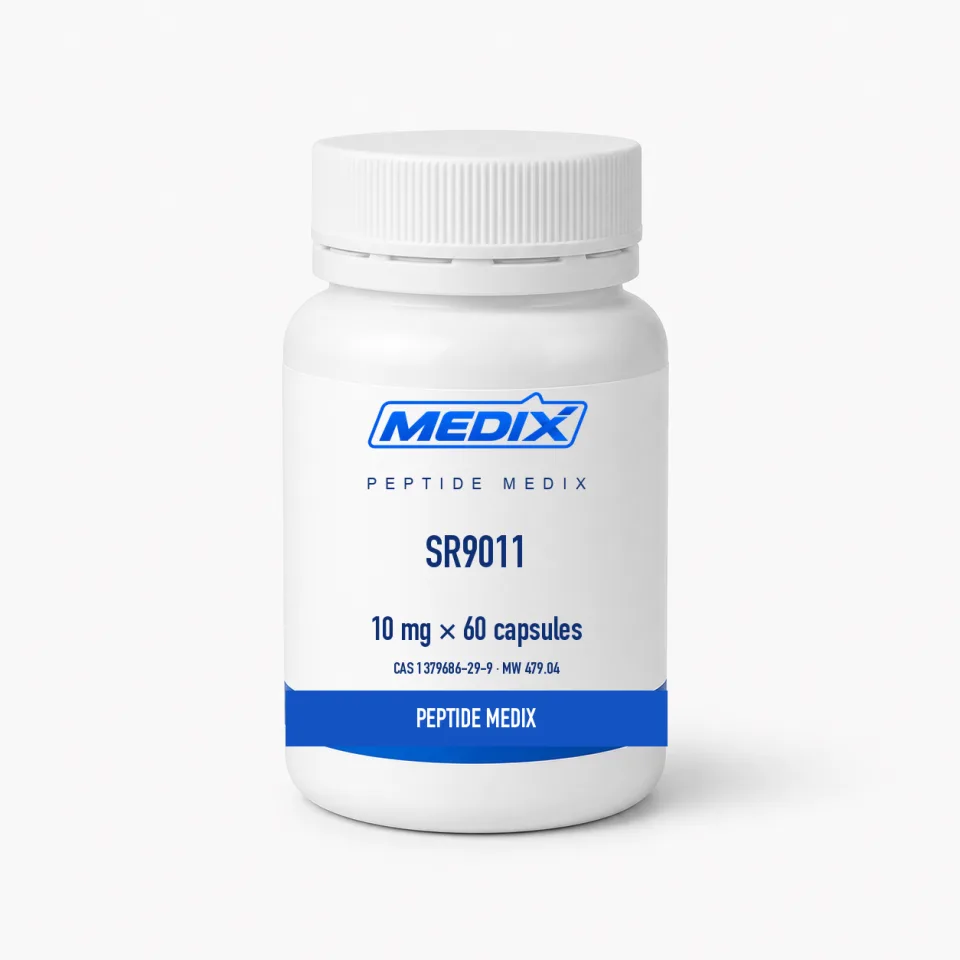
SR9011
Synthetic Rev-Erb agonist and SR9009 analog for circadian and metabolic research
- Mol. weight479.04 g/mol
- Research areasCircadian rhythm and sleep architecture, mitochondrial biogenesis, lipid and glucose metabolism, inflammatory signalling, tumour cell viability
Overview
SR9011 is not a peptide. It is a synthetic small molecule from the same medicinal-chemistry series as SR9009, developed in Thomas Burris's laboratory as an agonist of the Rev-Erb nuclear receptors REV-ERBα (NR1D1) and REV-ERBβ (NR1D2). These heme-binding receptors sit inside the core circadian feedback loop, where they repress transcription of BMAL1 and a wide set of downstream metabolic genes.
The two compounds share a pyrrolidine core and a chlorobenzyl-thiophene motif and differ in the amine substituents on the side chain, a change intended to improve pharmacokinetic behaviour relative to the earlier lead. In practice SR9011 and SR9009 are usually reported side by side in the same rodent studies, which is why the literature on one is difficult to read without the other.
Research interest concentrates on what happens downstream of Rev-Erb agonism: circadian gene expression, mitochondrial content in skeletal muscle, lipid and glucose handling, inflammatory signalling in macrophages, and — in later work — the viability of cancer cell lines. That literature is also the source of an important caveat, since some reported effects have been observed in cells lacking Rev-Erb receptors entirely. SR9011 is an unapproved research chemical with no medical use, supplied here for laboratory work only.
Specifications
Identity
- CAS number
- 1379686-29-9
- Molecular weight
- 479.04 g/mol
Supply & purity
- Purity
- HPLC tested for purity and identity; lot-matched COA available
Additional detail
- Compound class
- Synthetic small molecule; nuclear receptor (Rev-Erb) agonist — not a peptide
- Molecular targets
- REV-ERBα (NR1D1) and REV-ERBβ (NR1D2)
- Also known as
- SR-9011, SR 9011
- Structural relationship
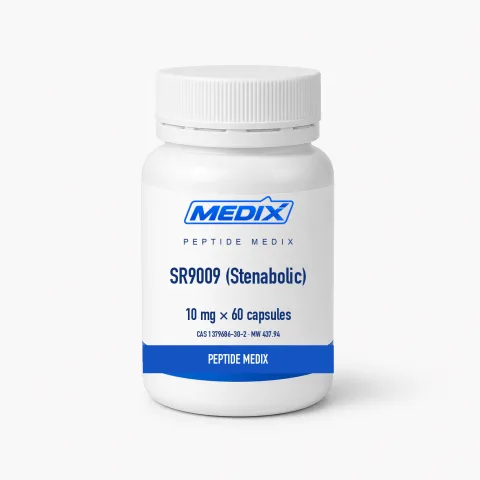
- Analog of SR9009 (Stenabolic) differing in the side-chain amine substituents
- Available formats
- 10 mg × 60 capsules; 30 mL solution at 20 mg/mL
- Mechanistic role
- Enhances Rev-Erb-mediated transcriptional repression of BMAL1 and downstream metabolic genes
- Research areas
- Circadian rhythm and sleep architecture, mitochondrial biogenesis, lipid and glucose metabolism, inflammatory signalling, tumour cell viability
- Reported pharmacokinetics
- Low oral exposure and short plasma half-life reported in mouse studies
- Regulatory status
- Not an approved medicine; not a dietary supplement; prohibited under the WADA metabolic-modulator category
- Storage
- Cool, dry and dark; keep the solution refrigerated and tightly capped
Units and conversions
There is no reconstitution step for a solid oral format: the mass per unit of SR9011 is fixed on the label. Where a published method is written in micrograms and the label is in milligrams, the peptide unit converter does the conversion.
Certificate of analysis
Every lot of SR9011 is released against a certificate of analysis: the batch-specific laboratory data for that lot, not a generic document for the compound. The lot number on the certificate matches the lot number printed on the label you receive — the vial label itself, where the product is vialled — so the record and the material it describes can always be reconciled.
Purity: HPLC tested for purity and identity — the specification for this listing. The figure for the lot you receive is the one reported on that lot’s certificate.
No lot certificate is on display on this page at the moment. That is a publishing state and not a testing one: lots are released and documented as described above whether or not the document is posted here, and we will send what exists for the lot in stock, or for a lot already on your bench, by its number.
Certificates are available on request before you order as well as after, with no account and no charge. Request the certificate for this listing, read the testing and documentation policy in full, or see how to read a peptide COA.
Questions about SR9011
Is SR9011 a SARM?
No. SARMs act on the androgen receptor. SR9011 is a Rev-Erb nuclear receptor agonist and belongs to a different pharmacological class entirely, which is why its research literature centres on circadian and metabolic gene expression rather than on androgen signalling.
Why do publications question its mechanism?
A 2019 report found that the closely related SR9009 produced several of its cellular effects in cells lacking both Rev-Erb receptors, implying receptor-independent activity. That finding applies by extension to this analog and is the reason current studies are expected to include Rev-Erb knockout controls.
What is the difference between the capsule and liquid formats?
The capsules give a fixed 10 mg unit quantity with no measuring step; the 30 mL solution at 20 mg/mL suits work where a volume-based aliquot or further dilution is needed. The compound and its lot documentation are the same for both.
What testing documentation is available?
Each lot is tested by HPLC for identity and purity and a lot-matched certificate of analysis is available on request. We do not claim any pharmaceutical-grade certification beyond third-party analytical testing, and the COA should be retained alongside your experimental records.
Related