- Component-level analytical testing
- Lot-matched certificate of analysis
- Ships next business day, tracked
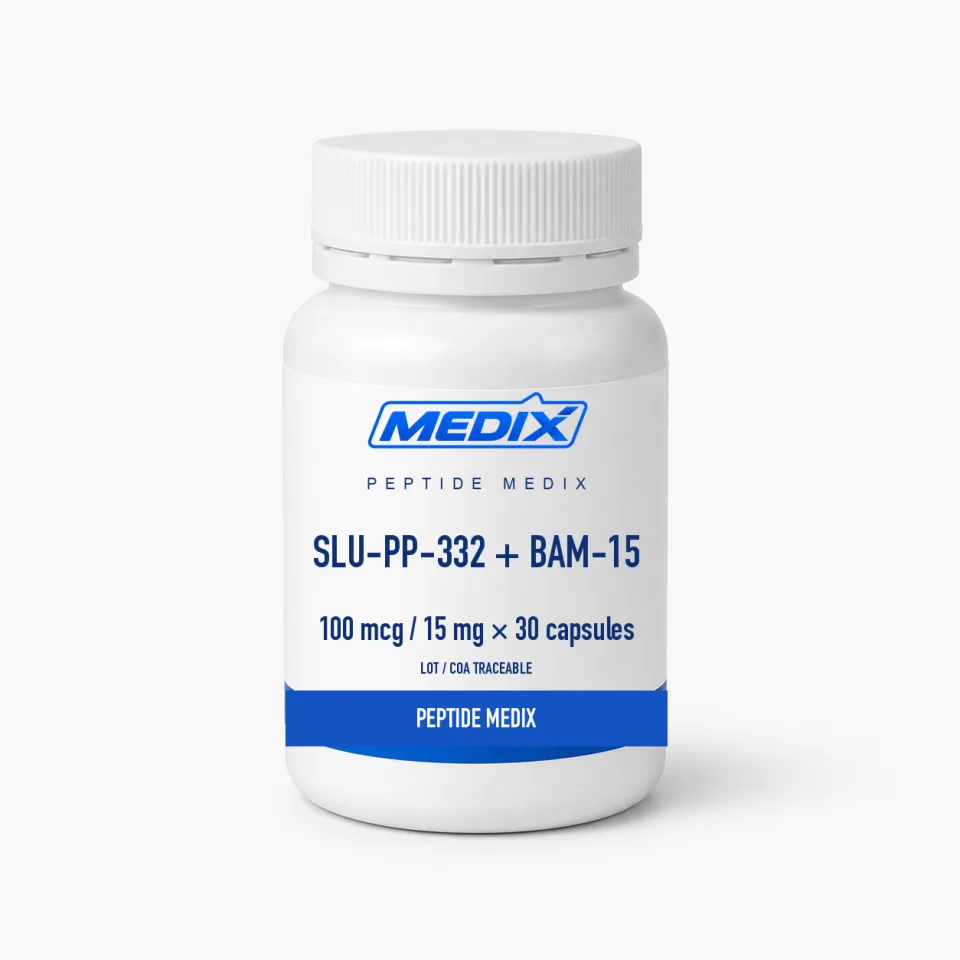
SLU-PP-332 + BAM-15
Two-compound capsule pairing an ERR agonist with a mitochondrial uncoupler
- FormCapsules in a sealed bottle, two-compound research blend
- Research areasMitochondrial biogenesis, oxidative phosphorylation efficiency, substrate oxidation
Overview
This capsule pairs two mechanistically different metabolic research compounds: 100 mcg of SLU-PP-332, a small-molecule agonist at the estrogen-related receptors, and 15 mg of BAM-15, a mitochondrial protonophore. The combination exists because the two act on separate levels of the same system — one changes what mitochondria a cell builds, the other changes how efficiently the mitochondria already present convert substrate to ATP.
SLU-PP-332 activates ERR alpha, beta and gamma, orphan nuclear receptors that, with PGC-1 coactivators, drive transcription of oxidative phosphorylation, tricarboxylic acid cycle and fatty-acid oxidation genes. That is a transcriptional effect measured over hours to days. BAM-15 works acutely and post-transcriptionally, shuttling protons across the inner mitochondrial membrane so part of the proton-motive force dissipates as heat rather than driving ATP synthase. It is described in the literature as a mitochondria-selective uncoupler that, unlike older protonophores such as DNP, does not depolarize the plasma membrane at comparable concentrations.
Specifications
Supply & purity
- Form
- Capsules in a sealed bottle, two-compound research blend
- Purity
- Component-level analytical testing; certificate of analysis available
Additional detail
- Composition per capsule
- 100 mcg SLU-PP-332 and 15 mg BAM-15
- Available size
- 30 capsules
- Component 1
- SLU-PP-332 — small-molecule agonist at ERR alpha, beta and gamma (CAS 2098486-97-2)
- Component 2
- BAM-15 — oxadiazolopyrazine-class mitochondrial protonophore (uncoupler)
- Compound class
- Small-molecule metabolic research blend (non-peptide)
- Research areas
- Mitochondrial biogenesis, oxidative phosphorylation efficiency, substrate oxidation
- Evidence base
- Cell culture and rodent studies only; no human data published for either component
- Storage
- Room temperature, sealed, dry and protected from light
Units and conversions
There is no reconstitution step for a solid oral format: the mass per unit of SLU-PP-332 + BAM-15 is fixed on the label. Where a published method is written in micrograms and the label is in milligrams, the peptide unit converter does the conversion.
Certificate of analysis
Every lot of SLU-PP-332 + BAM-15 is released against a certificate of analysis: the batch-specific laboratory data for that lot, not a generic document for the compound. The lot number on the certificate matches the lot number printed on the label you receive — the vial label itself, where the product is vialled — so the record and the material it describes can always be reconciled.
Purity: Component-level analytical testing — the specification for this listing. The figure for the lot you receive is the one reported on that lot’s certificate.
No lot certificate is on display on this page at the moment. That is a publishing state and not a testing one: lots are released and documented as described above whether or not the document is posted here, and we will send what exists for the lot in stock, or for a lot already on your bench, by its number.
Certificates are available on request before you order as well as after, with no account and no charge. Request the certificate for this listing, read the testing and documentation policy in full, or see how to read a peptide COA.
Questions about SLU-PP-332 + BAM-15
What is BAM-15?
BAM-15 is a small-molecule mitochondrial protonophore, meaning it carries protons across the inner mitochondrial membrane so part of the proton gradient dissipates as heat instead of driving ATP synthesis. It is described as mitochondria-selective, unlike older uncouplers that also affect the plasma membrane.
Why combine an ERR agonist with an uncoupler?
They operate at different levels. SLU-PP-332 changes which mitochondrial genes are transcribed over hours to days; BAM-15 changes the efficiency of existing mitochondria within minutes. Pairing them lets researchers test whether the two mechanisms add up or interfere.
What documentation is provided?
A certificate of analysis is available for the supplied lot, covering component identity and purity. Keeping that document with your experimental record maintains traceability between the analytical data and the material actually used.
How should the capsules be stored?
Store the sealed bottle at room temperature in a dry place away from direct light, and keep it closed between uses. Moisture uptake is the main storage risk for capsule-format material, so avoid refrigeration cycles that can cause condensation inside the bottle.
Related