- ≥99% by HPLC
- Lot-matched certificate of analysis
- Ships next business day, tracked
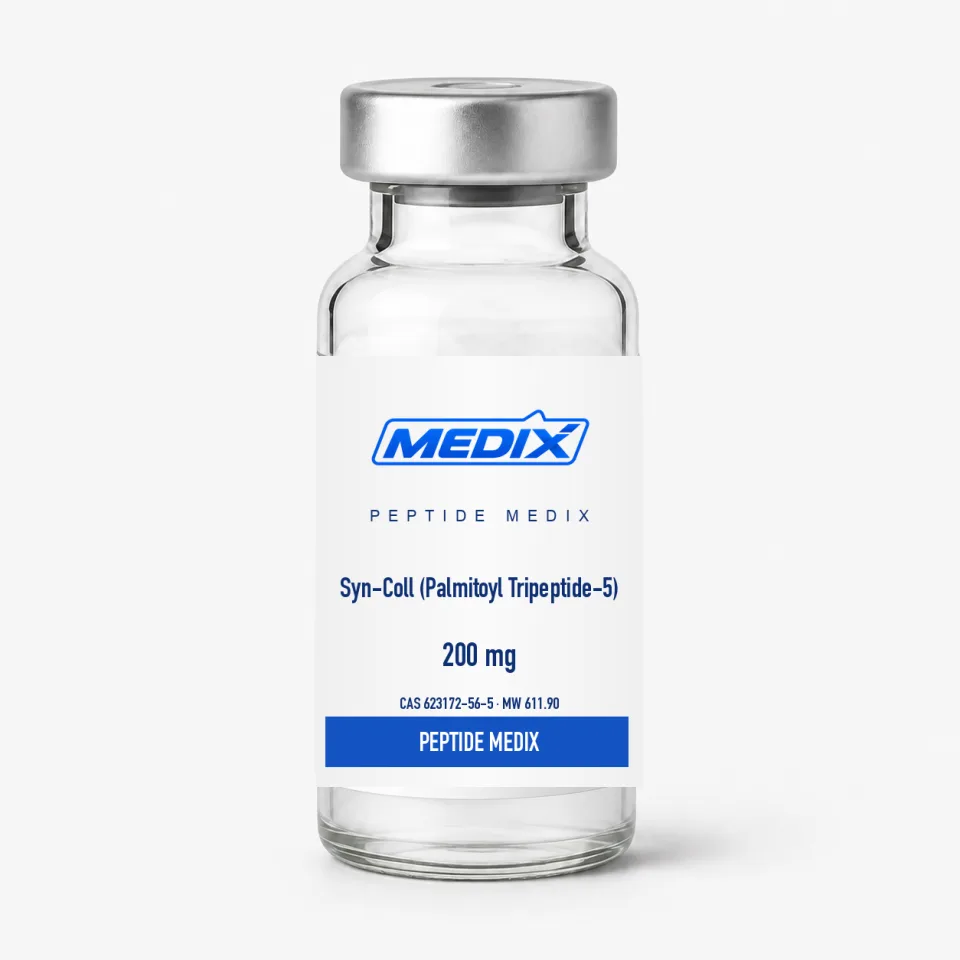
Syn-Coll (Palmitoyl Tripeptide-5)
Pal-KVK signal tripeptide for TGF-beta and matrix-model research
- FormLyophilized amphiphilic peptide powder, sealed glass vial
- Mol. weight611.90 g/mol as the free peptide
- Research areasTGF-beta signaling, fibroblast matrix output, collagen-associated markers and matrix-metalloproteinase models
Overview
Syn-Coll is the common trade-style name for Palmitoyl Tripeptide-5, a lipidated Lys-Val-Lys sequence written Pal-KVK. Its N-terminal C16 chain gives the peptide an amphiphilic character, while the basic lysine residues distinguish its charge and formulation behavior from other palmitoylated matrikines such as Pal-GHK and Pal-GQPR.
The compound was designed for extracellular-matrix research around transforming growth factor beta (TGF-beta) signaling and collagen-associated readouts. Studies and supplier dossiers have examined fibroblast matrix output, latent TGF-beta activation and matrix-metalloproteinase markers, but much of the evidence is formulation-specific or commercial. Direct analytical and single-agent controls are necessary before assigning an effect to Pal-KVK.
This 200 mg research vial contains Palmitoyl Tripeptide-5, formula C33H65N5O5 and molecular weight 611.90 g/mol. The peptide is HPLC tested with a lot-matched COA available. It is not a finished cosmetic and is supplied only for laboratory formulation and cell-model work.
Comparison with other lipidated matrikines is informative but should be handled carefully. Matrixyl is palmitoyl pentapeptide-4 built on the KTTKS sequence, Pal-GHK carries the copper-binding GHK motif, and Pal-GQPR is a distinct tetrapeptide; sharing a C16 chain does not imply a shared mechanism. The lysine-rich Pal-KVK core also behaves differently in anionic systems, so vehicle compatibility established for one palmitoylated peptide should be re-established here rather than carried across.
Specifications
Identity
- CAS number
- 623172-56-5
- Molecular formula
- C33H65N5O5
- Molecular weight
- 611.90 g/mol as the free peptide
- Peptide class
- Lipidated signal tripeptide
Supply & purity
- Form
- Lyophilized amphiphilic peptide powder, sealed glass vial
- Purity
- ≥99% by HPLC; lot-matched COA available
- Solubility
- Low water solubility; validate a co-solvent or surfactant vehicle
Additional detail
- Available size
- 200 mg
- Sequence
- Palmitoyl-Lys-Val-Lys-OH (Pal-KVK)
- Also known as
- Syn-Coll, Syn-Coll peptide, Palmitoyl Tripeptide-5
- Research areas
- TGF-beta signaling, fibroblast matrix output, collagen-associated markers and matrix-metalloproteinase models
- Storage
- −20 °C lyophilized, protected from light and moisture
Working out the concentration
Syn-Coll (Palmitoyl Tripeptide-5) ships as a lyophilized powder, so nothing on this page can state a concentration: the figure you work with is the one you create when you add diluent. Put the vial mass and the volume you intend to use into the peptide reconstitution calculator and it returns mg/mL, mcg/mL and the mass sitting at each mark on a U-100 syringe.
For work specified in µM or nM rather than mg/mL, feed 611.90 g/mol as the free peptide and your volume into the peptide molarity calculator.
Certificate of analysis
Every lot of Syn-Coll (Palmitoyl Tripeptide-5) is released against a certificate of analysis: the batch-specific laboratory data for that lot, not a generic document for the compound. The lot number on the certificate matches the lot number printed on the label you receive — the vial label itself, where the product is vialled — so the record and the material it describes can always be reconciled.
Purity: ≥99% by HPLC — the specification for this listing. The figure for the lot you receive is the one reported on that lot’s certificate.
No lot certificate is on display on this page at the moment. That is a publishing state and not a testing one: lots are released and documented as described above whether or not the document is posted here, and we will send what exists for the lot in stock, or for a lot already on your bench, by its number.
Certificates are available on request before you order as well as after, with no account and no charge. Request the certificate for this listing, read the testing and documentation policy in full, or see how to read a peptide COA.
Questions about Syn-Coll (Palmitoyl Tripeptide-5)
What is the sequence of Syn-Coll?
The defined peptide is Palmitoyl-Lys-Val-Lys-OH, abbreviated Pal-KVK. It is cataloged as Palmitoyl Tripeptide-5 and has a free-peptide molecular weight of 611.90 g/mol.
Is Syn-Coll the same as Matrixyl?
No. Matrixyl is most commonly associated with Palmitoyl Pentapeptide-4, sequence Pal-KTTKS. Syn-Coll is Palmitoyl Tripeptide-5, sequence Pal-KVK. They are distinct compounds and need separate pages and controls.
Is it the same as Palmitoyl Tripeptide-1?
No. Palmitoyl Tripeptide-1 is Pal-GHK, while this product is Pal-KVK. They share a lipidation strategy but not the peptide sequence or research rationale.
Why is a co-solvent sometimes needed?
The C16 palmitoyl group makes the molecule poorly soluble in plain water and prone to surface adsorption or self-association. A documented co-solvent or surfactant can improve reproducibility, provided the same vehicle is used in controls.
Related