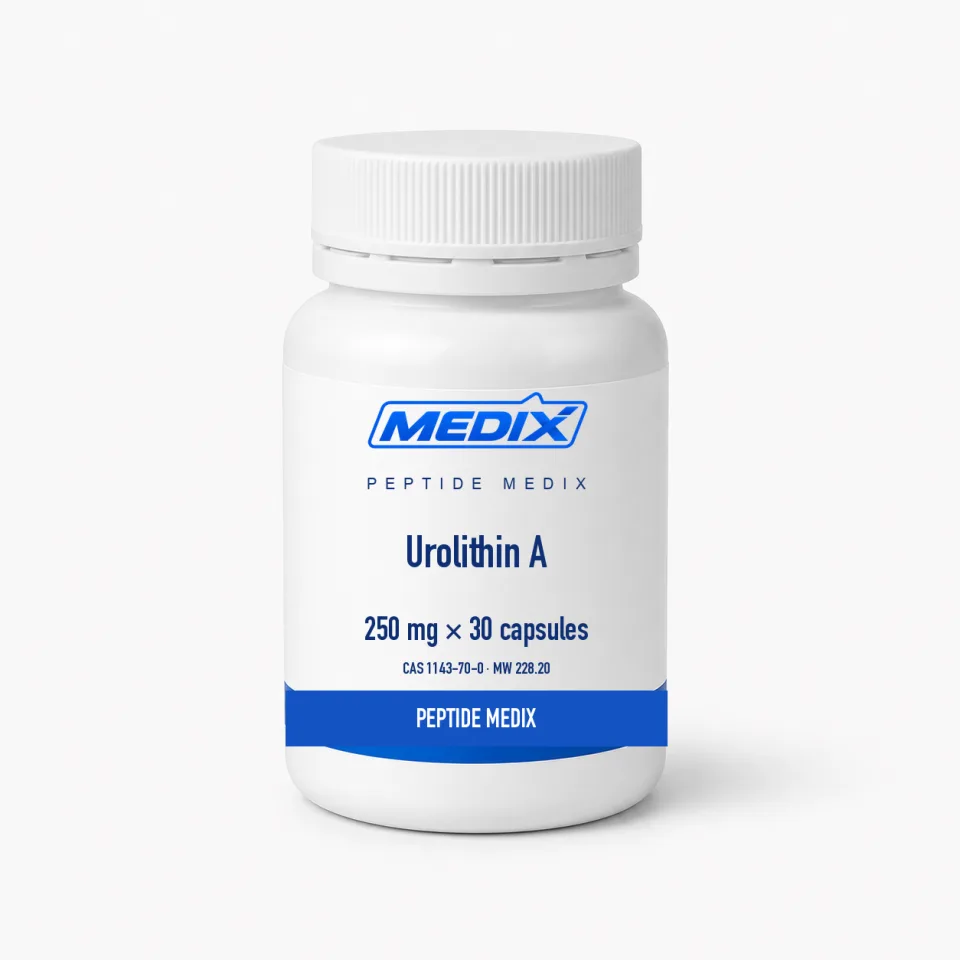
- ≥98% by HPLC
- Lot-matched certificate of analysis
- Ships next business day, tracked
Urolithin A
Gut-microbial ellagitannin metabolite studied in mitophagy research
- FormOff-white to pale beige crystalline powder in capsules; sealed bottle with desiccant
- Mol. weight228.20 g/mol
- Research areasMitophagy, mitochondrial biogenesis and quality control, skeletal muscle function, cellular senescence, inflammation models
Overview
Urolithin A is a small dibenzopyranone — 3,8-dihydroxy-urolithin, CAS 1143-70-0, formula C13H8O4, molecular mass 228.20 g/mol. It is not present in food directly. It is produced in the colon when gut bacteria metabolise ellagitannins and ellagic acid, the polyphenols abundant in pomegranate, walnuts and certain berries. Only a fraction of people carry a microbiome capable of that conversion, which is the practical reason interest shifted from the dietary precursors to the metabolite itself.
The compound entered the ageing literature after work reporting that it induces mitophagy — the selective autophagic clearance of damaged mitochondria — in C. elegans and rodent muscle. Because accumulation of dysfunctional mitochondria is a recurring feature of ageing tissue, a small molecule that appears to promote their turnover became a widely used tool for probing mitochondrial quality control alongside pathways such as PINK1/Parkin signalling and mitochondrial biogenesis markers.
Specifications
Identity
- CAS number
- 1143-70-0
- Molecular formula
- C13H8O4
- Molecular weight
- 228.20 g/mol
Supply & purity
- Form
- Off-white to pale beige crystalline powder in capsules; sealed bottle with desiccant
- Purity
- ≥98% by HPLC; lot-matched COA available
- Available sizes
- 250 mg × 30 capsules
- Solubility
- Poorly water-soluble; stocks are commonly prepared in DMSO for cell work
Additional detail
- Chemical name
- 3,8-dihydroxy-6H-dibenzo[b,d]pyran-6-one (3,8-dihydroxyurolithin)
- Chemical class
- Dibenzopyranone (urolithin) polyphenol metabolite
- Biological origin
- Colonic bacterial metabolism of ellagitannins and ellagic acid from pomegranate, walnuts and berries
- Research areas
- Mitophagy, mitochondrial biogenesis and quality control, skeletal muscle function, cellular senescence, inflammation models
- Metabolism note
- Extensively conjugated to glucuronide and sulfate forms in vivo, which analytical methods usually quantify alongside the free aglycone
- Storage
- Room temperature or cooler, sealed, protected from light and moisture
Units and conversions
Capsule and troche strengths are stated per unit, so the figure a method needs is usually a conversion rather than a dilution. The mcg to mg converter handles the milligram-to-microgram step, and the millilitre arithmetic if you are working from a solution format instead.
Certificate of analysis
Every lot of Urolithin A is released against a certificate of analysis: the batch-specific laboratory data for that lot, not a generic document for the compound. The lot number on the certificate matches the lot number printed on the label you receive — the vial label itself, where the product is vialled — so the record and the material it describes can always be reconciled.
Purity: ≥98% by HPLC — the specification for this listing. The figure for the lot you receive is the one reported on that lot’s certificate.
No lot certificate is on display on this page at the moment. That is a publishing state and not a testing one: lots are released and documented as described above whether or not the document is posted here, and we will send what exists for the lot in stock, or for a lot already on your bench, by its number.
Certificates are available on request before you order as well as after, with no account and no charge. Request the certificate for this listing, read the testing and documentation policy in full, or see how to read a peptide COA.
Questions about Urolithin A
Is Urolithin A found in pomegranate?
Not directly. Pomegranate, walnuts and some berries supply ellagitannins and ellagic acid; gut bacteria convert those precursors into urolithins in the colon. Human studies report that only a portion of people carry the microbial capacity to produce urolithin A efficiently, which is why the isolated metabolite is used in research.
What is the main research area for this compound?
Mitochondrial quality control. It became widely used after reports that it induces mitophagy — selective clearance of damaged mitochondria — in nematodes and rodent muscle, and it now appears across mitochondrial function, skeletal muscle, senescence and inflammation model systems.
What purity documentation comes with it?
Each lot is tested by HPLC to at least 98% and ships with a lot-matched certificate of analysis including identity confirmation. Quote the lot number printed on the bottle when requesting the document.
How does it relate to NMN or MOTS-c?
All three appear in mitochondrial and ageing research but act on different points. NMN feeds the NAD+ salvage pathway, MOTS-c is a mitochondrial-derived peptide affecting metabolic signalling, and urolithin A is studied for mitophagy and mitochondrial turnover. They are often examined comparatively rather than interchangeably.
Related