- Lot-matched certificate of analysis
- Ships next business day, tracked
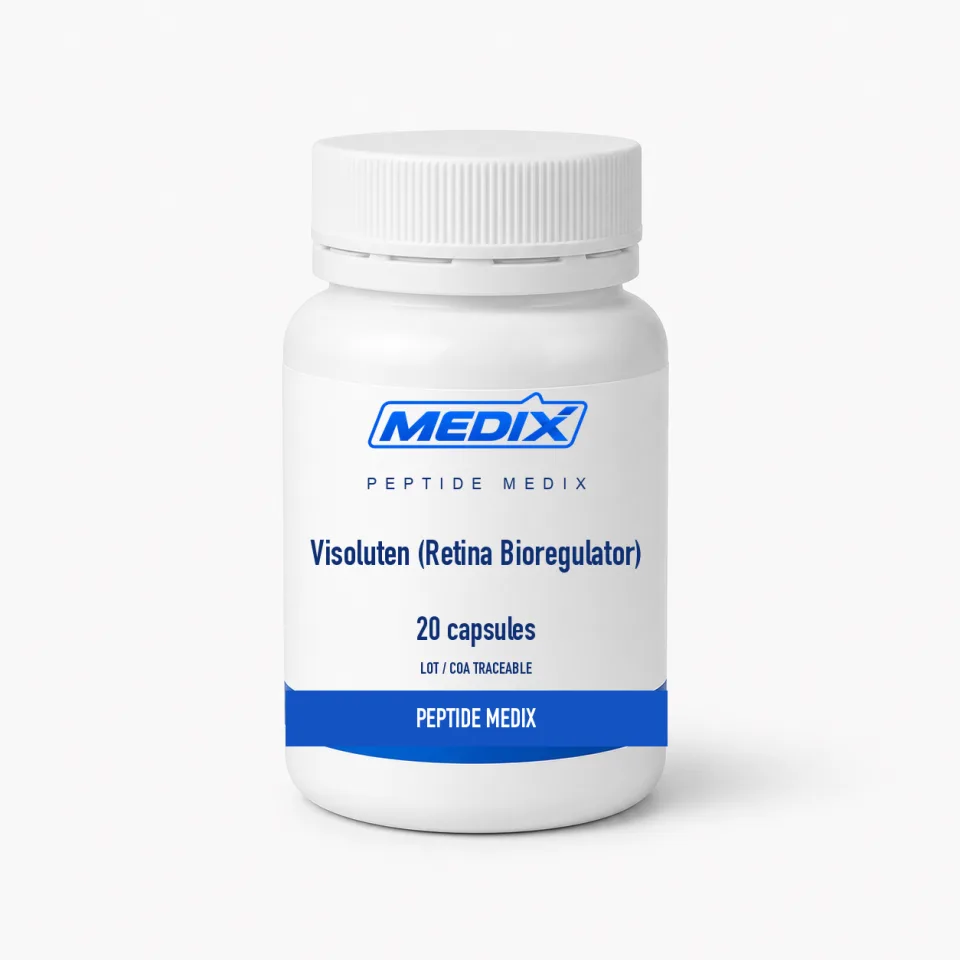
Visoluten (Retina Bioregulator)
Retina-derived peptide complex in capsules, from the Cytomax bioregulator range
- FormCapsules containing a lyophilized peptide complex with excipient carrier
- Mol. weightPolydisperse low-molecular-weight fraction; no single molecular mass applies
- Research areasRetinal ageing models, photoreceptor and pigment epithelium biology, tissue-derived peptide complexes, comparative bioregulator studies
Overview
Visoluten is the retina-associated member of the natural peptide bioregulator range developed within the Russian gerontology programme associated with Vladimir Khavinson. Unlike the synthetic tripeptides in the same family — Pinealon, Cartalax, Vesugen and their relatives — Visoluten is not a single defined sequence. It is a low-molecular-weight peptide complex prepared by controlled extraction and fractionation of bovine retinal tissue, then supplied in capsule form.
That distinction shapes everything about how the material is used. A defined tripeptide can be specified by sequence, formula and HPLC purity; a tissue-derived peptide complex is instead characterised by source tissue, extraction method, total peptide content and molecular-weight cut-off, typically in the region of a few kilodaltons or less. Bioregulator researchers work with these complexes on the premise that a tissue-specific mixture of short peptides carries information relevant to the tissue it came from — the founding idea of the whole programme, which began with organ extracts before the synthetic single-sequence generation followed.
Specifications
Identity
- Molecular weight
- Polydisperse low-molecular-weight fraction; no single molecular mass applies
Supply & purity
- Form
- Capsules containing a lyophilized peptide complex with excipient carrier
- Available sizes
- 20 capsules, 60 capsules
Additional detail
- Product type
- Natural peptide bioregulator (tissue-derived peptide complex)
- Source tissue
- Bovine retinal tissue
- Preparation
- Controlled extraction and fractionation to a low-molecular-weight peptide fraction
- Composition
- Peptide complex of undefined individual sequences; specified by total peptide content, not by a single formula
- Also known as
- Retina peptide bioregulator, Cytomax retina complex
- Bioregulator branch
- Natural extract range (Cytomax), as distinct from the synthetic peptide range (Cytogen)
- Associated tissue
- Retina and visual neural tissue
- Research areas
- Retinal ageing models, photoreceptor and pigment epithelium biology, tissue-derived peptide complexes, comparative bioregulator studies
- Storage
- 2–8 °C or cool room temperature in the sealed original container, protected from light, heat and humidity
- Documentation
- Lot documentation available on request
Units and conversions
The arithmetic on an oral format is unit arithmetic rather than dilution arithmetic. Use the milligram to microgram converter to line a per-unit figure up against a method written in different units.
Certificate of analysis
Every lot of Visoluten (Retina Bioregulator) is released against its own lot documentation, and where the manufacturer issues a certificate of analysis for it, that certificate is the record for the lot rather than a generic document for the compound. The lot number on the certificate matches the lot number printed on the label you receive — the vial label itself, where the product is vialled — so the record and the material it describes can always be reconciled.
This listing carries no purity percentage, so none is claimed for it here. Where the manufacturer issues analytical documentation for a lot of this item, it is passed on unaltered — ask and we will send whatever exists.
No lot certificate is on display on this page at the moment. That is a publishing state and not a testing one: lots are released and documented as described above whether or not the document is posted here, and we will send what exists for the lot in stock, or for a lot already on your bench, by its number.
Certificates are available on request before you order as well as after, with no account and no charge. Request the certificate for this listing, read the testing and documentation policy in full, or see how to read a peptide COA.
Questions about Visoluten (Retina Bioregulator)
Why is no amino acid sequence listed?
Because Visoluten is not a single peptide. It is a low-molecular-weight fraction extracted from retinal tissue — a mixture of short peptides whose individual sequences are not separately specified. Products in the synthetic branch of the range, such as Pinealon or Cartalax, do have defined sequences.
What is the difference between natural and synthetic bioregulators?
Natural preparations like Visoluten are tissue extracts fractionated to a low-molecular-weight peptide range. Synthetic bioregulators are single, chemically defined sequences reproduced by solid-phase synthesis. The synthetic branch is reproducible and mechanistically attributable; the natural branch retains whatever mixture effects may exist.
What documentation is supplied?
Lot documentation is available on request. For a tissue-derived complex this reports source tissue, total peptide content and molecular-weight distribution rather than the HPLC purity figure used for the synthetic peptides elsewhere in this catalogue — a single purity percentage is not meaningful for a mixture.
How should Visoluten be stored?
In the sealed original container, protected from light, heat and humidity, either refrigerated at 2–8 °C or in a cool dry cabinet. Peptide complexes are hygroscopic, so avoid decanting into secondary containers and keep the pack closed between uses.
Is it related to any eye medicine?
No. It carries no approved indication in the United States or elsewhere in this catalogue's markets, is not an ophthalmic preparation, and is not sterile or formulated for ocular contact. It is research material derived from retinal tissue, nothing more.
How strong is the published evidence?
Limited. Most work on tissue-derived peptide bioregulators comes from a small number of institutions, largely in regional journals, with sparse independent replication. Tissue-specificity claims remain unestablished outside those groups, so cross-tissue extract controls are advisable in any study design.