- Lot-matched certificate of analysis
- Ships next business day, tracked
Vitamin D3 (Cholecalciferol)
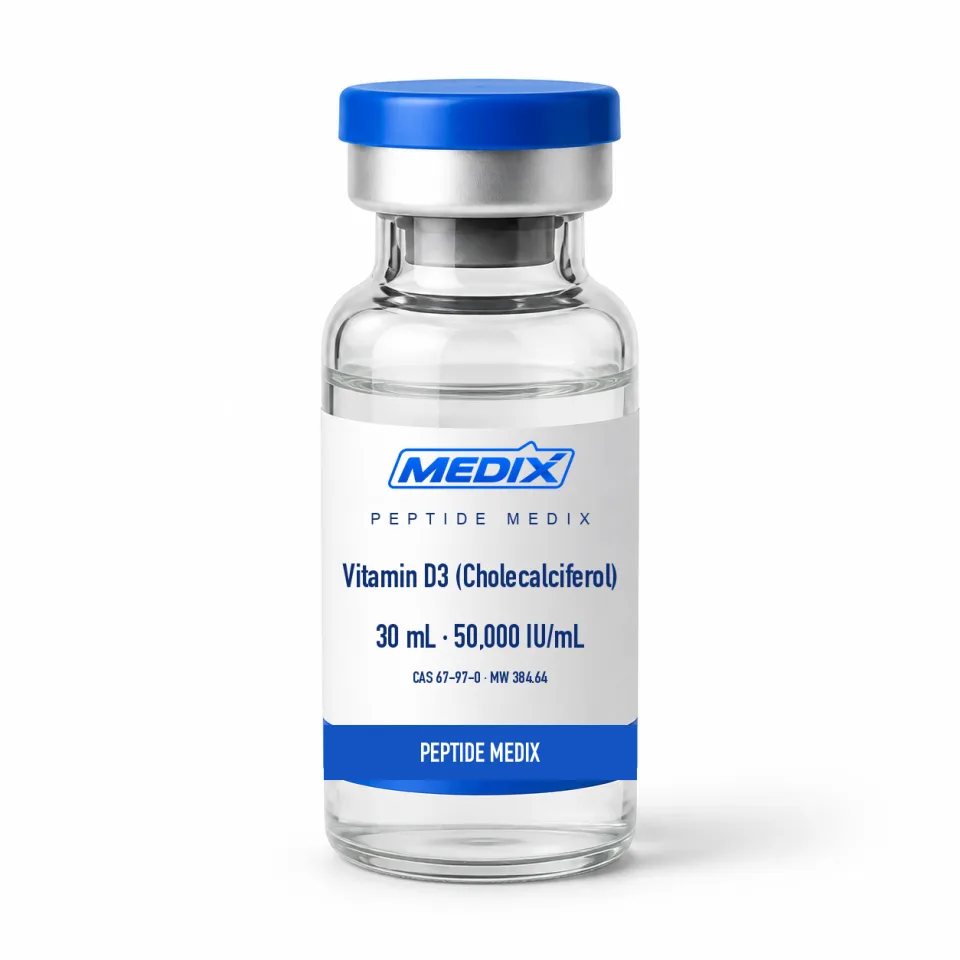
Cholecalciferol solution at 50,000 IU/mL in a 30 mL vial
- FormOil-miscible solution in a sealed vial
- Mol. weight384.64 g/mol
- Research areasCalcium and phosphate homeostasis, VDR gene regulation, immune cell differentiation, bone biology models
Overview
Vitamin D3, chemically cholecalciferol, is a secosteroid — a steroid whose B ring has been broken, in this case by the ultraviolet photolysis of 7-dehydrocholesterol in skin. That open-ring structure gives the molecule its characteristic flexible triene system and distinguishes it from the classic four-ring steroid hormones it otherwise resembles.
Cholecalciferol is not itself the active species. It undergoes 25-hydroxylation in the liver to form calcifediol (25-hydroxyvitamin D3), the circulating form measured in status assays, and then 1-alpha-hydroxylation in the kidney by CYP27B1 to yield calcitriol, the hormonally active ligand for the nuclear vitamin D receptor. That receptor heterodimerizes with RXR and regulates hundreds of genes, which is why the vitamin D axis appears in calcium homeostasis research, immunology, cell differentiation studies and gene-regulation work far beyond bone biology.
Supplied as a 50,000 IU/mL solution in a 30 mL vial. Because 1 IU corresponds to 0.025 µg of cholecalciferol, that concentration equals 1.25 mg/mL. The compound is lipophilic and oxidation-sensitive, so light and air exposure are the main stability concerns. Lot-matched Certificate of Analysis available.
Specifications
Identity
- CAS number
- 67-97-0
- Molecular formula
- C27H44O
- Molecular weight
- 384.64 g/mol
Supply & purity
- Form
- Oil-miscible solution in a sealed vial
Additional detail
- Concentration
- 50,000 IU/mL (1.25 mg/mL cholecalciferol)
- Vial size
- 30 mL
- Also known as
- Cholecalciferol, vitamin D3, calciol
- Chemical class
- Secosteroid (9,10-secosteroid), fat-soluble vitamin
- IU conversion
- 1 IU = 0.025 µg cholecalciferol; 40,000 IU = 1 mg
- Metabolic pathway
- 25-hydroxylation to calcifediol, then 1-alpha-hydroxylation to calcitriol
- Molecular target
- Nuclear vitamin D receptor (VDR), heterodimerizing with RXR
- Research areas
- Calcium and phosphate homeostasis, VDR gene regulation, immune cell differentiation, bone biology models
- Storage
- Controlled room temperature or refrigerated, tightly sealed, protected from light and air
Units and conversions
Because this is supplied at a stated strength, the question is rarely how much diluent to add — it is what that strength looks like in the units your method is written in. Convert mcg to mg, mL to µL and back with the unit converter.
Certificate of analysis
Every lot of Vitamin D3 (Cholecalciferol) is released against its own lot documentation, and where the manufacturer issues a certificate of analysis for it, that certificate is the record for the lot rather than a generic document for the compound. The lot number on the certificate matches the lot number printed on the label you receive — the vial label itself, where the product is vialled — so the record and the material it describes can always be reconciled.
This listing carries no purity percentage, so none is claimed for it here. Where the manufacturer issues analytical documentation for a lot of this item, it is passed on unaltered — ask and we will send whatever exists.
No lot certificate is on display on this page at the moment. That is a publishing state and not a testing one: lots are released and documented as described above whether or not the document is posted here, and we will send what exists for the lot in stock, or for a lot already on your bench, by its number.
Certificates are available on request before you order as well as after, with no account and no charge. Request the certificate for this listing, read the testing and documentation policy in full, or see how to read a peptide COA.
Questions about Vitamin D3 (Cholecalciferol)
What is vitamin D3?
Vitamin D3, or cholecalciferol, is a secosteroid formed when ultraviolet light cleaves the B ring of 7-dehydrocholesterol. It is the precursor to calcifediol and to calcitriol, the hormone that activates the nuclear vitamin D receptor.
How much cholecalciferol is 50,000 IU?
One IU corresponds to 0.025 µg of cholecalciferol, so 50,000 IU equals 1.25 mg. At the supplied concentration of 50,000 IU/mL, the solution contains 1.25 mg/mL, and a 30 mL vial holds 37.5 mg total.
Is cholecalciferol the active form?
No. It requires two hydroxylation steps: hepatic 25-hydroxylation to calcifediol, then renal 1-alpha-hydroxylation to calcitriol, which is the receptor-active hormone. Studies of receptor activation in vitro generally use calcitriol rather than cholecalciferol.
How should this solution be handled?
Keep the vial sealed and shielded from light, minimize headspace and temperature cycling, and dilute through a compatible organic carrier for aqueous work. The conjugated triene is sensitive to light, oxygen and heat, all of which drive isomerization and oxidation.
Is this lot tested?
Yes. Each lot is supplied with a lot-matched Certificate of Analysis documenting identity, concentration and purity, available for review before purchase so the material can be checked against your acceptance criteria.
Related