- Peptide purity inputs: ≥99% by HPLC for both actives
- Lot-matched certificate of analysis
- Ships next business day, tracked
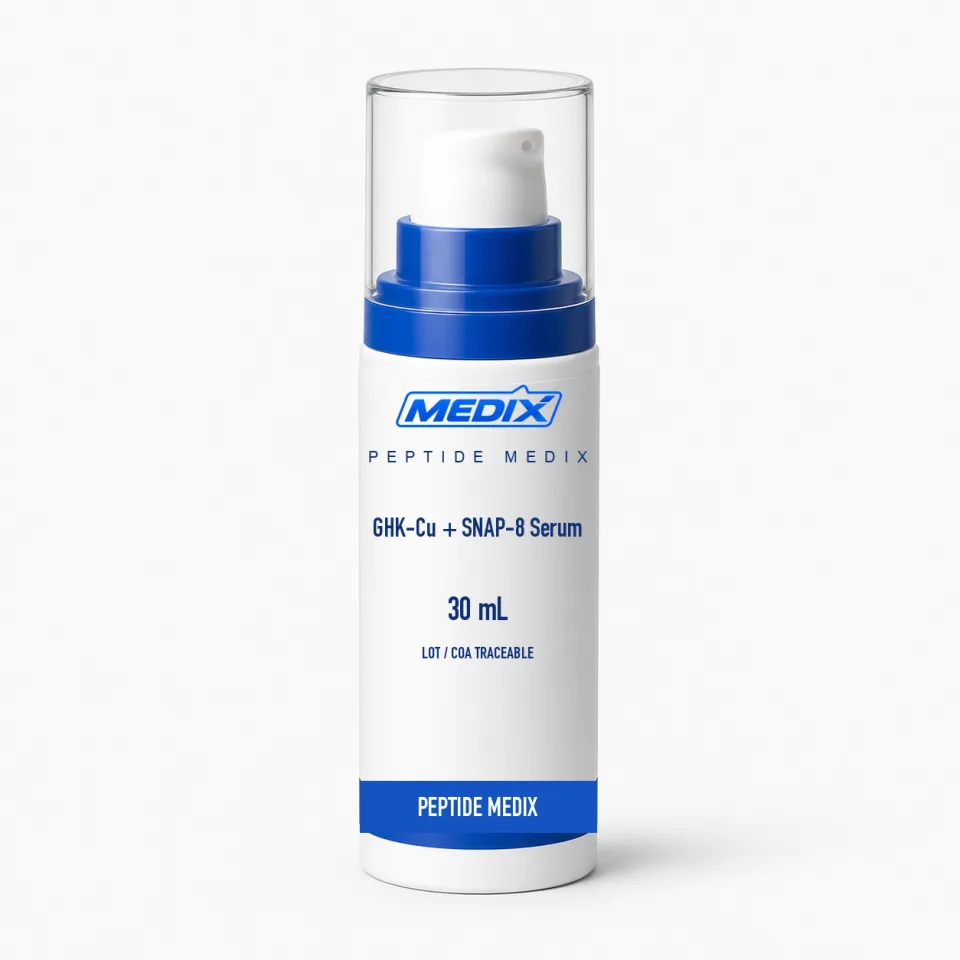
GHK-Cu + SNAP-8 Serum
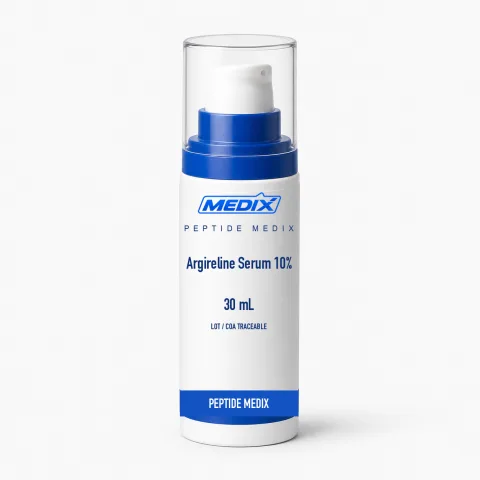
Two-active serum pairing copper tripeptide-1 with acetyl octapeptide-3, 30 mL
- FormBlue-tinted aqueous serum in a 30 mL bottle
- Research areasCombination-formulation studies, ECM endpoints, SNARE-assembly models, co-penetration
Overview
This 30 mL serum carries two peptides that act on entirely different biology, which is precisely why they are combined in cosmetic-research formulations. GHK-Cu, the copper(II) complex of glycyl-L-histidyl-L-lysine, belongs to the matrix side of the literature: it has been studied for fibroblast behaviour, collagen and glycosaminoglycan output, metalloproteinase balance and antioxidant chemistry. SNAP-8, or acetyl octapeptide-3, belongs to the neuro-mimetic side: it copies the N-terminal region of SNAP-25 and is examined for interference with SNARE complex assembly, the machinery behind vesicle fusion.
Because the two mechanisms are independent, combination formulations are used to ask whether the endpoints are additive, whether one active alters penetration of the other, and whether a shared aqueous vehicle can hold a charged metal complex and a small hydrophilic peptide without either degrading. Copper complexes are sensitive to competing ligands and SNAP-8 carries an oxidation-prone methionine, so formulation compatibility is itself a research question here.
The serum is supplied in a single 30 mL size. Both peptide inputs are third-party tested to ≥99% by HPLC with lot-matched certificates of analysis, and the finished bottle is lot-numbered, filled and shipped from the United States for laboratory research only.
Specifications
Supply & purity
- Form
- Blue-tinted aqueous serum in a 30 mL bottle
Additional detail
- Available size
- 30 mL
- Active 1
- GHK-Cu — copper(II) complex of glycyl-L-histidyl-L-lysine (INCI copper tripeptide-1)
- Active 1 identifiers
- CAS 89030-95-5 · C14H24N6O4·Cu · 403.93 g/mol
- Active 2
- SNAP-8 — acetyl octapeptide-3, Ac-Glu-Glu-Met-Gln-Arg-Arg-Ala-Asp-NH2
- Active 2 identifiers
- CAS 868844-74-0 · C41H70N16O16S · 1075.16 g/mol
- Peptide purity inputs
- ≥99% by HPLC for both actives; lot-matched COAs available
- Concentrations
- Printed on the lot label; comparable research serums typically run GHK-Cu at 1–3% and SNAP-8 near 1%
- Vehicle
- Lightweight aqueous base, no added fragrance or colourant
- Research areas
- Combination-formulation studies, ECM endpoints, SNARE-assembly models, co-penetration
- Storage
- 2–8 °C preferred, protected from light; keep the closure tight
- Compatibility note
- Reducing agents disturb copper coordination; the SNAP-8 methionine is oxidation-sensitive
Units and conversions
Because this is supplied at a stated strength, the question is rarely how much diluent to add — it is what that strength looks like in the units your method is written in. Convert mcg to mg, mL to µL and back with the unit converter.
Certificate of analysis
Every lot of GHK-Cu + SNAP-8 Serum is released against a certificate of analysis: the batch-specific laboratory data for that lot, not a generic document for the compound. The lot number on the certificate matches the lot number printed on the label you receive — the vial label itself, where the product is vialled — so the record and the material it describes can always be reconciled.
Peptide purity inputs: ≥99% by HPLC for both actives — the specification for this listing. The figure for the lot you receive is the one reported on that lot’s certificate.
No lot certificate is on display on this page at the moment. That is a publishing state and not a testing one: lots are released and documented as described above whether or not the document is posted here, and we will send what exists for the lot in stock, or for a lot already on your bench, by its number.
Certificates are available on request before you order as well as after, with no account and no charge. Request the certificate for this listing, read the testing and documentation policy in full, or see how to read a peptide COA.
Questions about GHK-Cu + SNAP-8 Serum
Why combine GHK-Cu and SNAP-8?
They act through unrelated mechanisms. GHK-Cu is studied for matrix and fibroblast endpoints, while SNAP-8 is studied for competition at the SNARE assembly interface. Combining them lets a study ask whether structural and dynamic endpoints can be addressed together, and whether the actives interfere with one another.
What concentrations does the serum contain?
Concentrations for the shipped lot are printed on the container label and stated on the accompanying documentation. Comparable research serums in this category typically run GHK-Cu somewhere between 1% and 3% with SNAP-8 close to 1%, but the lot label is the authoritative figure for your bottle.
Is the peptide in this formulation tested, and is a COA available?
Yes. The peptide input is released against a ≥99% HPLC purity specification with mass-spectrometric identity confirmation, and the lot-matched certificate of analysis is available on request. Each finished container is labelled with its own lot number so bench records can be tied back to the raw-material certificate.
Are the two actives chemically compatible?
Compatibility is one of the reasons this format is studied. Copper can promote oxidation of the methionine residue in SNAP-8, and competing ligands can strip copper from the tripeptide. Stability work should follow both actives separately by chromatography rather than assuming the pair behaves like either alone.
What are the right control arms for an experiment?
Single-active preparations in the same vehicle. Our GHK-Cu serum and lyophilized SNAP-8 are built on the same peptide specifications as the actives here, so they serve as matched controls and let any additive or interfering effect be attributed properly.
How should the serum be stored?
Hold it at 2–8 °C with the closure tight and away from light. Dispense with a clean pipette, never return unused material, and log the lot number with the date the bottle was first opened. Discard for quantitative purposes if the blue colour fades or shifts.
Related