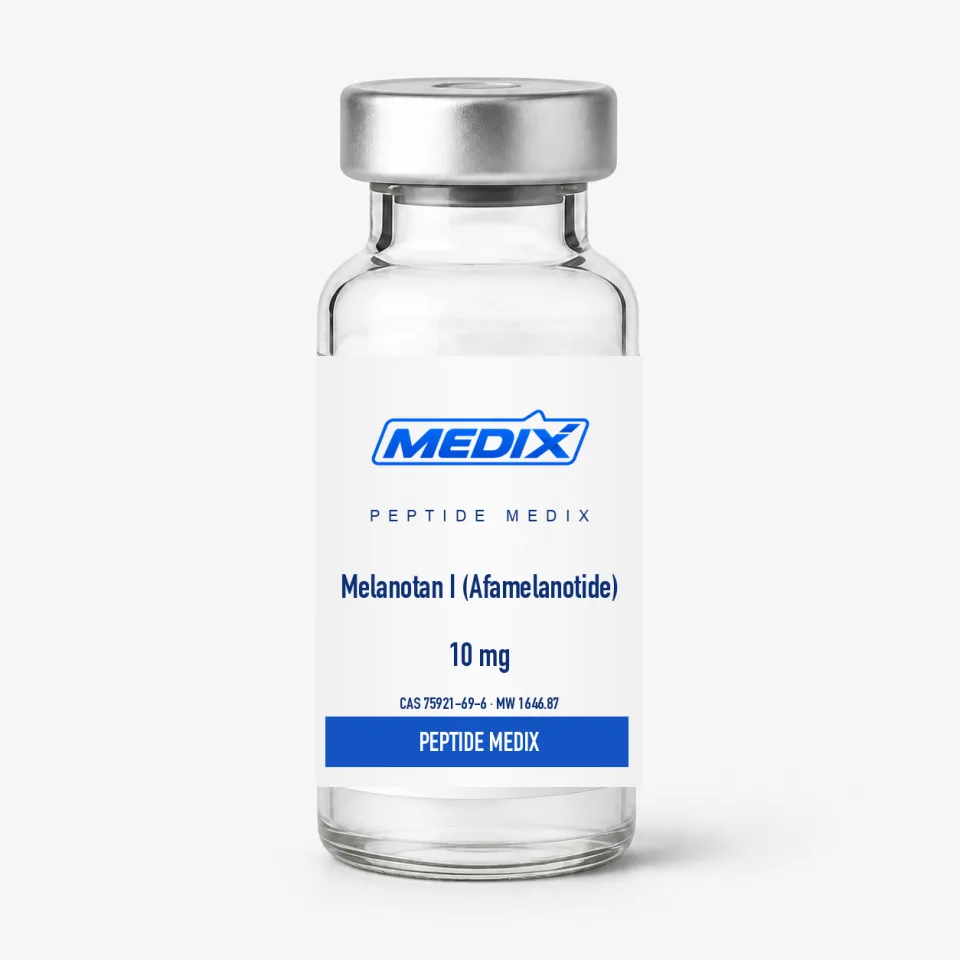
- ≥99% by HPLC, confirmed by mass spectrometry
- Lot-matched certificate of analysis
- Ships next business day, tracked
Melanotan I (Afamelanotide)
Afamelanotide — 13-amino-acid α-MSH analog for melanocortin receptor research
- FormWhite to off-white lyophilized powder in a sealed glass vial
- Mol. weight1646.87 g/mol
- Research areasMelanogenesis, eumelanin synthesis, MC1R signalling, UV-response models
Overview
Melanotan I, also catalogued as afamelanotide, is a synthetic 13-amino-acid analog of alpha-melanocyte-stimulating hormone (α-MSH). It carries two deliberate substitutions relative to the native hormone — norleucine at position 4 and D-phenylalanine at position 7 — which came out of structure–activity work on melanocortin ligands and which slow enzymatic breakdown while preserving receptor binding. The molecule is a linear, C-terminally amidated tridecapeptide that behaves in laboratory systems as a long-lived melanocortin receptor agonist.
Unlike the cyclic lactam Melanotan II, Melanotan I keeps the open-chain α-MSH backbone and is reported to have a comparatively narrower melanocortin profile, with its strongest described activity at the MC1R subtype expressed on melanocytes. That relative selectivity is why it turns up mainly in pigmentation, photobiology and receptor-signalling work rather than in the appetite or sexual-behaviour models where broader melanocortin coverage is wanted.
Specifications
Identity
- CAS number
- 75921-69-6
- Molecular formula
- C78H111N21O19
- Molecular weight
- 1646.87 g/mol
- Amino acid sequence
- Ac-Ser-Tyr-Ser-Nle-Glu-His-D-Phe-Arg-Trp-Gly-Lys-Pro-Val-NH2
- Peptide class
- Linear α-MSH (melanocortin) analog, tridecapeptide
Supply & purity
- Form
- White to off-white lyophilized powder in a sealed glass vial
- Purity
- ≥99% by HPLC, confirmed by mass spectrometry; lot-matched COA
- Available sizes
- 10 mg, 20 mg
- Solubility
- Bacteriostatic water or sterile water; aqueous stocks kept cold and dark
Handling & storage
- Storage (lyophilized)
- −20 °C, sealed, protected from light and moisture
- Storage (reconstituted)
- 2–8 °C, short study window; avoid repeated freeze–thaw
Additional detail
- Primary target
- Melanocortin receptors, with reported preference for MC1R
- Research areas
- Melanogenesis, eumelanin synthesis, MC1R signalling, UV-response models
Working out the concentration
The vial sizes above — 10 mg, 20 mg — describe a mass of material, not a strength. Choose a diluent volume, work it out with the reconstitution calculator, and you have the concentration for your own vial of Melanotan I (Afamelanotide) plus the volume that carries any mass you want to withdraw.
Where a method is written in molar terms instead, the molecular weight above — 1646.87 g/mol — is the input the molarity calculator needs.
Certificate of analysis
Every lot of Melanotan I (Afamelanotide) is released against a certificate of analysis: the batch-specific laboratory data for that lot, not a generic document for the compound. The lot number on the certificate matches the lot number printed on the label you receive — the vial label itself, where the product is vialled — so the record and the material it describes can always be reconciled.
Purity: ≥99% by HPLC, confirmed by mass spectrometry — the specification for this listing. The figure for the lot you receive is the one reported on that lot’s certificate.
No lot certificate is on display on this page at the moment. That is a publishing state and not a testing one: lots are released and documented as described above whether or not the document is posted here, and we will send what exists for the lot in stock, or for a lot already on your bench, by its number.
Certificates are available on request before you order as well as after, with no account and no charge. Request the certificate for this listing, read the testing and documentation policy in full, or see how to read a peptide COA.
Questions about Melanotan I (Afamelanotide)
What is Melanotan I and how does it differ from α-MSH?
It is a synthetic tridecapeptide analog of alpha-melanocyte-stimulating hormone with norleucine substituted at position 4 and D-phenylalanine at position 7. Those two changes were reported to slow enzymatic degradation and extend receptor interaction, so the analog behaves as a longer-lived melanocortin agonist than the native hormone in laboratory assays.
How is Melanotan I different from Melanotan II?
Melanotan I is the full-length linear peptide with activity weighted toward MC1R. Melanotan II is a shorter cyclic lactam analog with broader melanocortin receptor coverage, including MC3R and MC4R. Researchers often compare the two to distinguish pigment-pathway signalling from wider melanocortin system effects.
Is this lot third-party tested, and can I see the COA?
Yes. Every production lot is analysed by an independent laboratory for identity and purity — HPLC with mass-spectrometric confirmation — and the lot-matched certificate of analysis is available on request before purchase. The COA states the lot number, assay result and test date so it can be filed with your experimental records.
What sizes are available and what is in the vial?
Melanotan I is stocked in 10 mg and 20 mg lyophilized vials. Each vial contains only the peptide as a freeze-dried cake, with no diluent, preservative or excipient added, so the laboratory controls the reconstitution vehicle and final concentration.
How should the powder and any solution be stored?
Keep the sealed lyophilate at −20 °C away from light and moisture, where it is stable for extended periods. Once dissolved, hold the solution at 2–8 °C, protect it from light, and use it within a short defined study window rather than storing it long term.
What is it dissolved in for laboratory work?
Bacteriostatic water or sterile water is the usual choice; the peptide is readily water-soluble. Add diluent gently against the vial wall and swirl instead of shaking. Solvent choice should be documented alongside concentration because it affects stability in aqueous storage.
Related