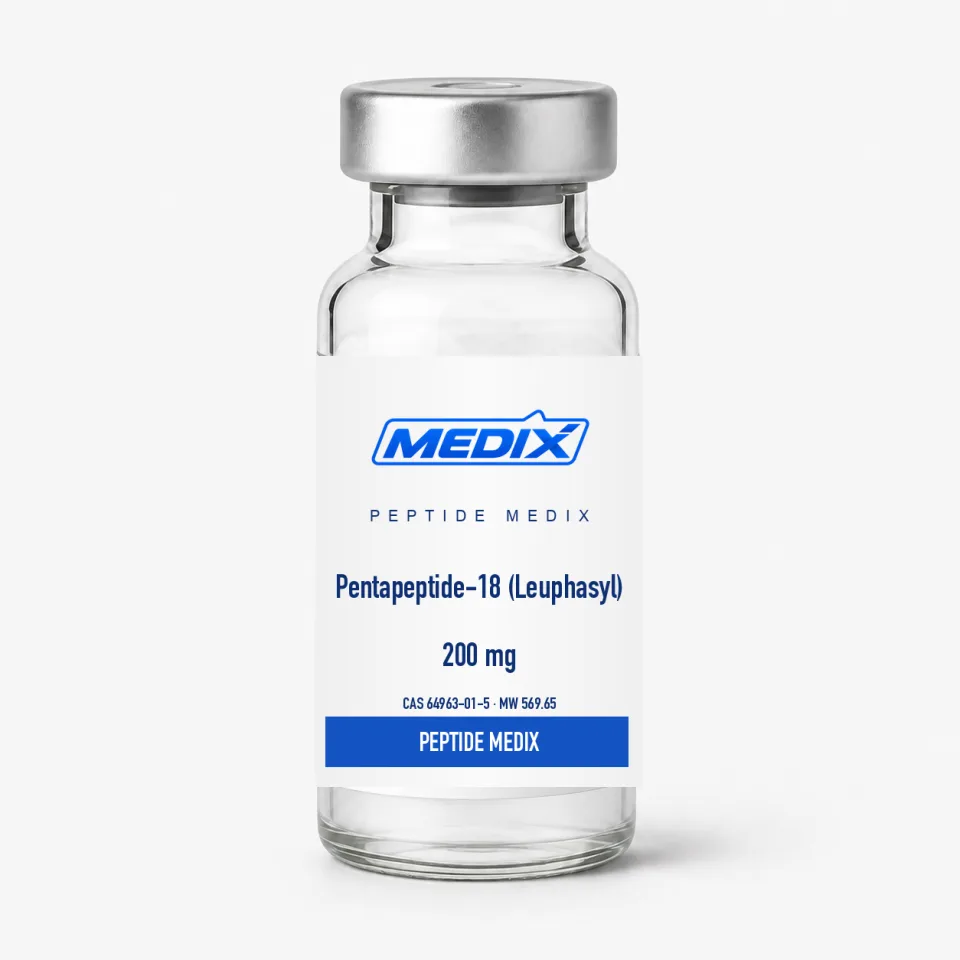
- ≥99% by HPLC
- Lot-matched certificate of analysis
- Ships next business day, tracked
Pentapeptide-18 (Leuphasyl)
D-Ala2 leucine-enkephalin analog for neurotransmitter-release models
- FormLyophilized powder, sealed glass vial
- Mol. weight569.65 g/mol
- Research areasNeurotransmitter-release models, contraction-associated assays and comparative cosmetic-peptide formulation
Overview
Pentapeptide-18 is a synthetic five-residue peptide with sequence Tyr-D-Ala-Gly-Phe-Leu, also called Leuphasyl or [D-Ala2]leucine-enkephalin. Replacing the second residue with D-alanine fixes the stereochemical identity and differentiates it from ordinary leucine-enkephalin, whose native sequence is Tyr-Gly-Gly-Phe-Leu; the substitution therefore sits at the first of the two glycine positions and is a long-standing device in enkephalin structure–activity work for slowing aminopeptidase cleavage. The molecule is cataloged under CAS 64963-01-5 with formula C29H39N5O7 and molecular weight 569.65 g/mol.
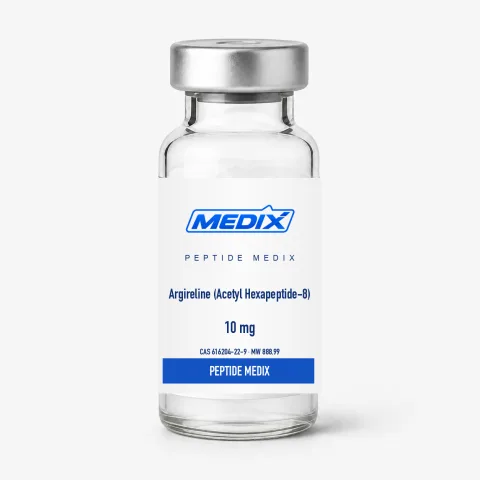
Cosmetic-peptide research has examined Pentapeptide-18 in neurotransmitter-release and contraction-associated model systems, often beside Argireline, SNAP-8, Syn-AKE or Vialox. Those materials act through different proposed steps, so a useful study compares them under the same cell, tissue and vehicle conditions rather than grouping them as interchangeable “expression peptides.” Unlike the palmitoylated actives it is frequently benchmarked against, Pentapeptide-18 carries no lipid modification and behaves as an ordinary water-soluble small peptide, which changes both its formulation requirements and what can reasonably be expected of it in a permeation experiment.
Specifications
Identity
- CAS number
- 64963-01-5
- Molecular formula
- C29H39N5O7
- Molecular weight
- 569.65 g/mol
- Amino acid sequence
- Tyr-D-Ala-Gly-Phe-Leu-OH
- Chain length
- 5 residues
- Peptide class
- Synthetic enkephalin-related pentapeptide
Supply & purity
- Form
- Lyophilized powder, sealed glass vial
- Purity
- ≥99% by HPLC; lot-matched COA available
Additional detail
- Available size
- 200 mg
- Also known as
- Leuphasyl, Pentapeptide-18, [D-Ala2]leucine-enkephalin
- Research areas
- Neurotransmitter-release models, contraction-associated assays and comparative cosmetic-peptide formulation
- Storage
- −20 °C lyophilized; protect from light and moisture
Working out the concentration
Because Pentapeptide-18 (Leuphasyl) arrives dry, its concentration is a decision rather than a specification. Run the numbers through the reconstitution calculator — vial mass in, diluent volume in, mg/mL and mass per syringe unit out.
Certificate of analysis
Every lot of Pentapeptide-18 (Leuphasyl) is released against a certificate of analysis: the batch-specific laboratory data for that lot, not a generic document for the compound. The lot number on the certificate matches the lot number printed on the label you receive — the vial label itself, where the product is vialled — so the record and the material it describes can always be reconciled.
Purity: ≥99% by HPLC — the specification for this listing. The figure for the lot you receive is the one reported on that lot’s certificate.
No lot certificate is on display on this page at the moment. That is a publishing state and not a testing one: lots are released and documented as described above whether or not the document is posted here, and we will send what exists for the lot in stock, or for a lot already on your bench, by its number.
Certificates are available on request before you order as well as after, with no account and no charge. Request the certificate for this listing, read the testing and documentation policy in full, or see how to read a peptide COA.
Questions about Pentapeptide-18 (Leuphasyl)
What is the sequence of Pentapeptide-18?
The defined sequence is Tyr-D-Ala-Gly-Phe-Leu-OH. The D configuration of the second alanine is part of the identity and should be retained in analytical records and comparison materials.
Is Pentapeptide-18 the same as leucine-enkephalin?
It is closely related but not identical. Pentapeptide-18 is [D-Ala2]leucine-enkephalin; the D-alanine substitution changes conformation and enzymatic stability relative to the native all-L peptide.
How does it differ from Argireline or Syn-AKE?
The three compounds have different sequences and proposed targets. Pentapeptide-18 is enkephalin-related, Argireline is a SNAP-25-derived hexapeptide, and Syn-AKE is a modified diaminobutyroyl benzylamide compound. They should be separate product entities.
What purity documentation is available?
The peptide is released at ≥99% by reversed-phase HPLC, with a certificate of analysis matched to the product lot available. Mass confirmation should correspond to the D-Ala-containing free-acid form.
How should the vial be stored?
Keep lyophilized material at −20 °C, sealed and protected from light and moisture. Refrigerate short-term working solutions and use aliquots for longer study periods to limit repeated freeze–thaw exposure.
Related