- Lot-matched certificate of analysis
- Ships next business day, tracked
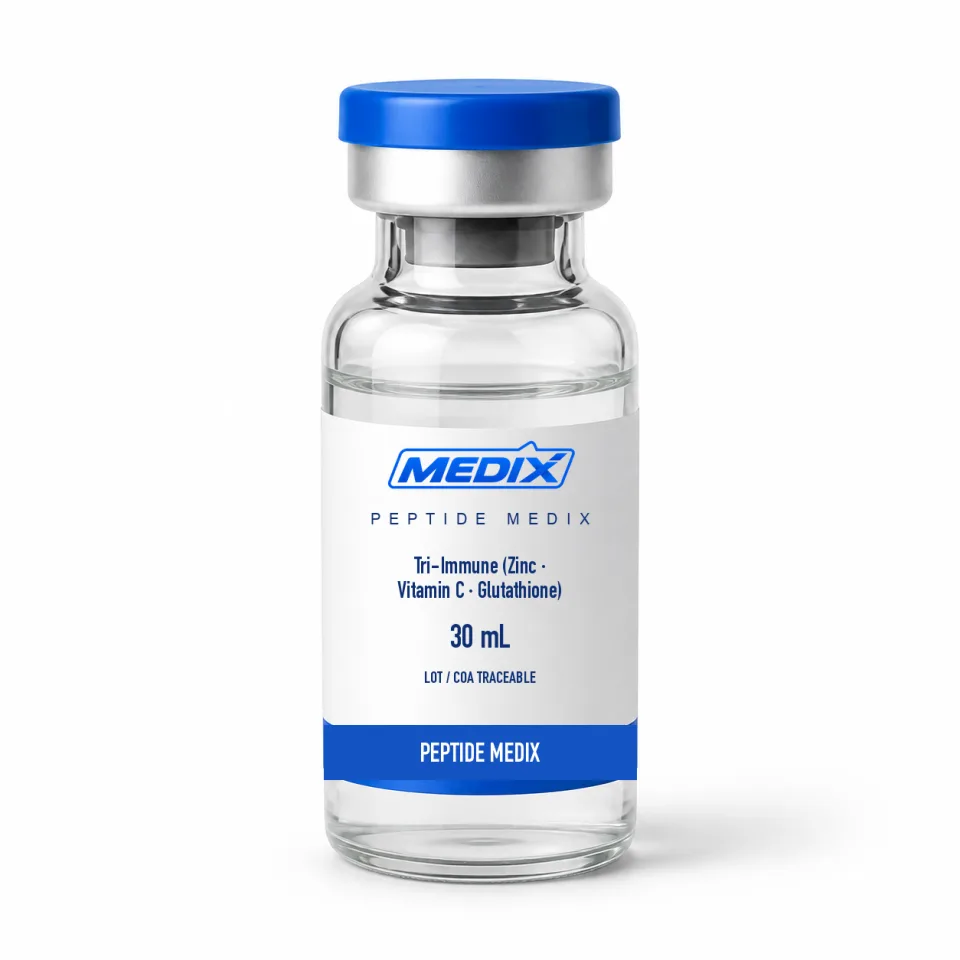
Tri-Immune (Zinc · Vitamin C · Glutathione)
Three-component research solution: zinc, ascorbic acid and reduced glutathione
- Research areasMicronutrient cofactor availability, redox buffering, lymphocyte and macrophage assays, metallothionein and zinc-finger studies
Overview
Zinc is a structural and catalytic cofactor for several hundred enzymes and for zinc-finger transcription factors, and its availability affects thymic output, lymphocyte proliferation and metallothionein expression in published models. Ascorbic acid (CAS 50-81-7, C6H8O6, 176.12 g/mol) is a water-soluble reductant and the required cofactor for dioxygenases including prolyl hydroxylases and the TET DNA demethylases. Reduced glutathione (CAS 70-18-8, C10H17N3O6S, 307.32 g/mol) is the dominant intracellular thiol buffer and the substrate of glutathione peroxidases and S-transferases.
The combination is chemically interactive by design and by consequence: ascorbate and glutathione are both reductants that participate in the same recycling network, while zinc is a redox-inert transition metal whose coordination chemistry can be influenced by thiol availability. Concentrations for each component are printed on the vial label and restated on the lot-matched Certificate of Analysis.
Units and conversions
Tri-Immune (Zinc · Vitamin C · Glutathione) arrives already made up, so there is no diluent volume to choose and no reconstitution step. What is left is unit work — percent to mg/mL, milligrams to micrograms, millilitres to microlitres — and the mcg to mg converter does all three.
Certificate of analysis
Every lot of Tri-Immune (Zinc · Vitamin C · Glutathione) is released against its own lot documentation, and where the manufacturer issues a certificate of analysis for it, that certificate is the record for the lot rather than a generic document for the compound. The lot number on the certificate matches the lot number printed on the label you receive — the vial label itself, where the product is vialled — so the record and the material it describes can always be reconciled.
This listing carries no purity percentage, so none is claimed for it here. Where the manufacturer issues analytical documentation for a lot of this item, it is passed on unaltered — ask and we will send whatever exists.
No lot certificate is on display on this page at the moment. That is a publishing state and not a testing one: lots are released and documented as described above whether or not the document is posted here, and we will send what exists for the lot in stock, or for a lot already on your bench, by its number.
Certificates are available on request before you order as well as after, with no account and no charge. Request the certificate for this listing, read the testing and documentation policy in full, or see how to read a peptide COA.
Questions about Tri-Immune (Zinc · Vitamin C · Glutathione)
What is in the vial?
Three components in one 30 mL aqueous solution: zinc, ascorbic acid and reduced L-glutathione. The per-component concentration is printed on the vial label and restated on the lot-matched Certificate of Analysis, so calculations can be checked against a documented value.
Is this a peptide product?
Only in part. Glutathione is a gamma-linked tripeptide, while zinc is a trace element and ascorbic acid a water-soluble vitamin. The preparation is catalogued under vitamins and cofactors rather than with the peptide vials for that reason.
Is a COA available?
Yes. A lot-matched Certificate of Analysis is available for the batch you receive, documenting component identity and concentration. Match the lot number printed on the vial to the COA before recording any results.
Can the components be varied independently?
Not in this format — the ratio is fixed by the fill. Studies that need to titrate zinc, ascorbate or glutathione separately should use the single-component products, which are stocked individually, and use this blend only where a constant combined input is wanted.
Related